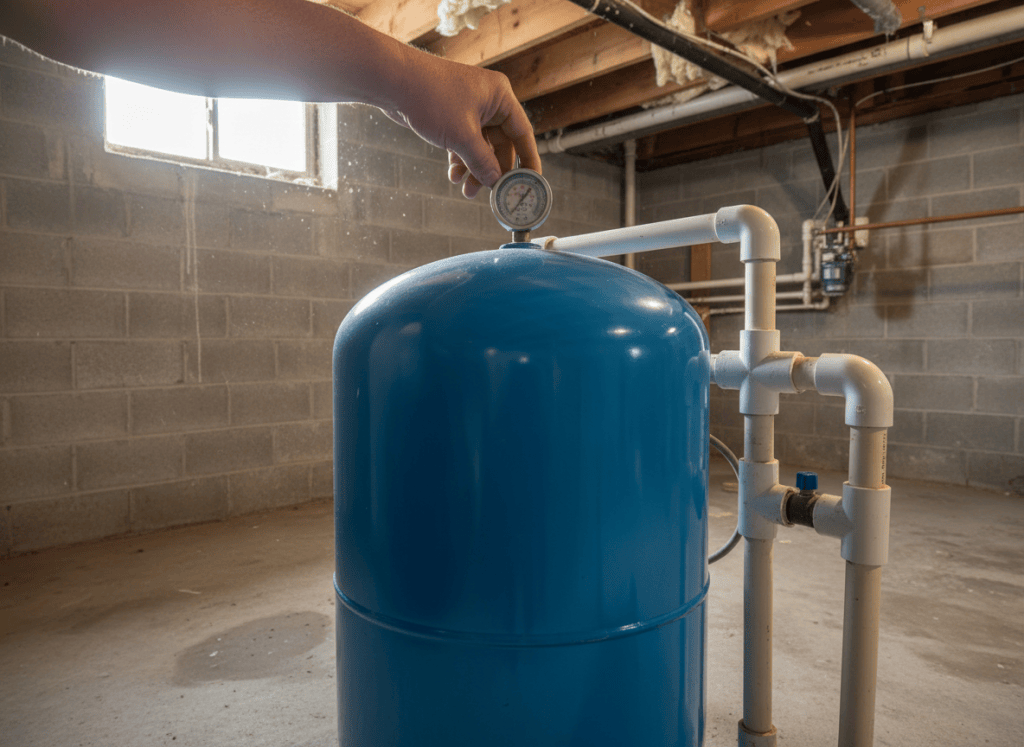
Quick answer: Set the air charge in a bladder or diaphragm pressure tank to 2 psi below your pump’s cut-in pressure: 28 psi for a 30/50 switch and 38 psi for a 40/60 switch. You can only measure it correctly with the pump off and the tank drained of water. Check it with an ordinary tire gauge on the tank’s air valve at least once a year. If water comes out of the air valve, the bladder has failed and the tank needs replacing.
Why the air charge matters
A pressure tank holds a cushion of compressed air above (or around) a rubber bladder or diaphragm. When you open a tap, the air pushes water out, so the pump doesn’t have to start for every glass of water. When the air charge is wrong:
- Too low: the tank holds less usable water, the pump starts more often, and the bladder is overstretched.
- Too high: the tank can’t fill properly and pressure fluctuates.
Either way, the pump works harder and wears out sooner. A correct air charge is one of the cheapest ways to protect your pump.
The rule: 2 psi below cut-in
Amtrol’s Well-X-Trol manual says to set the precharge 2 psi below the pressure switch cut-in, and gives the example of 38 psi for a 40/60 switch.
| Pressure switch | Cut-in | Tank air charge |
|---|---|---|
| 20/40 | 20 psi | 18 psi |
| 30/50 | 30 psi | 28 psi |
| 40/60 | 40 psi | 38 psi |
Not sure of your switch setting? Watch the pressure gauge: the pressure where the pump turns on is your cut-in. Our pressure switch settings guide explains more.
Factory precharge varies by tank model, so always check a new tank before installing it.
How to check and set the air charge
You’ll need a tire pressure gauge and an air compressor or bike pump.
- Turn off power to the pump at the breaker.
- Drain the tank. Open a faucet near the tank (or the tank’s drain valve) and let it run until the water stops and the pressure gauge reads zero.
- Remove the cap from the air valve on the top or side of the tank. It looks like a tire valve.
- Measure with the tire gauge.
- Adjust. Add air with the compressor, or press the valve pin to let air out, until you reach cut-in minus 2 psi.
- Close the faucet, restore power, and let the pump refill the tank. Watch it through a cycle to confirm the switch turns on and off at the right pressures.
Check it once a year. Amtrol also recommends having a professional check the complete system yearly, and more often as it ages.
Is your tank waterlogged?
A waterlogged tank has lost its air cushion. Signs:
- The pump turns on and off every few seconds while water is running (short cycling).
- Pressure swings noticeably in the shower.
- Water sprays out when you press the air valve pin. This means the bladder is ruptured.
- The knock test: tap the tank from top to bottom. A healthy tank sounds hollow at the top (air) and dull at the bottom (water). A waterlogged tank sounds dull all the way up.
Low air but no water from the valve: recharge the air as above and recheck in a few weeks. If it keeps losing air, the valve or tank is leaking.
Water from the air valve: the bladder has failed. On most modern tanks the bladder can’t be replaced, so the tank must be replaced.
Tank safety
Pressure tanks are pressurized vessels. Amtrol warns that tanks can corrode and weaken over time and may burst. Replace a tank that is rusted, dented or leaking, and never exceed its maximum working pressure (printed on the label).
Frequently asked questions
What should the air pressure be in my well tank?
2 psi below your pump’s cut-in pressure: 28 psi for 30/50, 38 psi for 40/60.
Can I check tank pressure without draining it?
No. With water in the tank, the gauge reads the water pressure, not the air charge. Drain it first.
How long does a well pressure tank last?
It varies with water quality and how often the pump cycles. A correct air charge and yearly checks help it last longer.
Why does my pump keep turning on and off?
Usually a waterlogged tank or low air charge. See well pump short cycling.
Related guides
Sources
- Amtrol – Well-X-Trol Installation, Operation and Maintenance Manual
- Fresh Water Systems – 4 Well Pressure Tank Problems and How to Fix Them
- Mid Atlantic Water – Well Pump Pressure Switch: 30/50 vs 40/60
This guide is for general information. Follow your tank manufacturer’s instructions.


Leave a comment