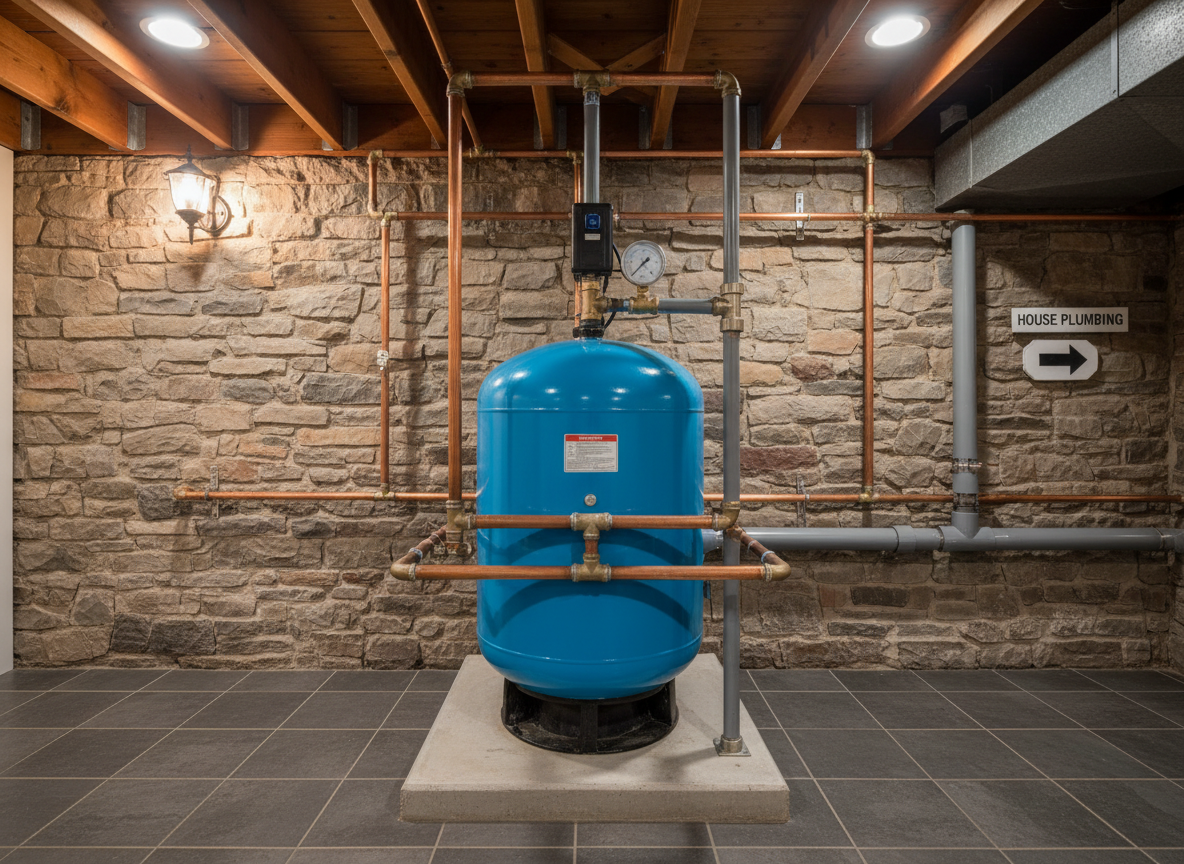
Quick answer: Short cycling means the pump turns on and off every few seconds instead of running for a minute or two. The most common cause is a waterlogged pressure tank (failed bladder) or low tank air charge. Other causes are a leaking check valve, a leak in the plumbing, a clogged pressure switch tube or an undersized tank. Short cycling overheats the pump motor, so fix it quickly.
What normal cycling looks like
When you open a tap, pressure drops to the cut-in (for example 40 psi), the pump starts, runs until pressure reaches the cut-out (60 psi) and stops. A healthy system runs for at least a minute or two per cycle and then rests.
Short cycling looks like this: with water running, the pump clicks on and off every few seconds, and the pressure gauge needle swings quickly between the two settings.
Why it’s a problem
Each time a pump motor starts, it draws a surge of current and heats up. A normal cycle gives the motor time to cool between starts. Constant starting overheats the windings and wears out the start components, pressure switch contacts and bearings. A pump that could last many years can fail far sooner under constant short cycling.
Common causes
| Cause | Clue |
|---|---|
| Waterlogged tank (failed bladder) | Water comes out of the tank’s air valve; the tank sounds “full” all the way up |
| Low air charge | Air (not water) comes from the valve, but the reading is below cut-in minus 2 psi |
| Leaking check valve | Pressure falls quickly after the pump stops, even with every tap closed |
| Plumbing or buried line leak | Pressure falls slowly with all taps closed; wet spots or a running toilet |
| Clogged pressure switch tube | Erratic cycling; iron or sediment sludge in the small pipe under the switch |
| Undersized tank | Tank is small for the pump’s flow; cycles are short even with correct air |
Step-by-step diagnosis
1. The air valve test. Turn off the pump. Briefly press the pin in the air valve on the tank.
- Water sprays out → the bladder has failed. Replace the tank.
- Only air comes out → go to step 2.
2. Check the air charge. Drain the tank and check the air with a tire gauge. It should be 2 psi below the cut-in (28 psi for 30/50, 38 psi for 40/60). If it’s low, recharge it. Full steps: how to check pressure tank air pressure.
3. The pressure-hold test. Let the pump fill the tank and shut off. Close every tap and make sure no toilet is running, water softener is regenerating or ice maker is filling. Watch the gauge:
- Pressure drops fast (within seconds or a minute) → a leaking check valve is likely letting water flow back down the well.
- Pressure drops slowly over many minutes → there’s a leak somewhere in the pipes or fixtures.
- Pressure holds → the tank and check valve are probably fine; look at the pressure switch.
4. Inspect the pressure switch. With the power off, remove the switch and check the small pipe (nipple) under it for iron or sediment buildup. Clean or replace it. Look for burnt or pitted contacts. See pressure switch settings and failure signs.
Fixes and who should do them
| Fix | DIY? |
|---|---|
| Recharge tank air | Yes: tire gauge and compressor |
| Clean the switch sensing tube | Yes, with the power off |
| Replace the pressure switch | Possible if you are comfortable with electrical work |
| Replace a pressure tank | Handy homeowners often do; follow the manufacturer’s steps |
| Replace a check valve in the well | Call a pump contractor; it may require pulling the pump |
| Find a buried line leak | Usually a professional job |
Frequently asked questions
Why does my well pump turn on and off every few seconds?
Most often a waterlogged pressure tank or low air charge. Test the air valve first.
Can short cycling damage my well pump?
Yes. Repeated starts overheat the motor and wear out electrical parts. Fix it promptly.
Why does my pump turn on when no water is being used?
Water is leaving the system somewhere: a leaking check valve sending water back down the well, or a leak in the plumbing. Do the pressure-hold test.
Can a water softener cause short cycling?
A softener regenerating or a running toilet can trigger extra cycles. Make sure nothing is using water during the pressure-hold test.
Related guides
- Pressure tank air pressure: how to check and set it
- Well pump pressure switch settings: 30/50 vs 40/60
- Sediment in well water
Sources
- The Well Guide – Well Pump Short Cycling: Causes, Diagnosis, and How to Fix It
- Fresh Water Systems – 4 Well Pressure Tank Problems and How to Fix Them
- Amtrol – Well-X-Trol Installation and Operation Manual
This guide is for general information. Turn off power before working on any pump component, and call a licensed pump installer for work in the well.
Leave a Reply