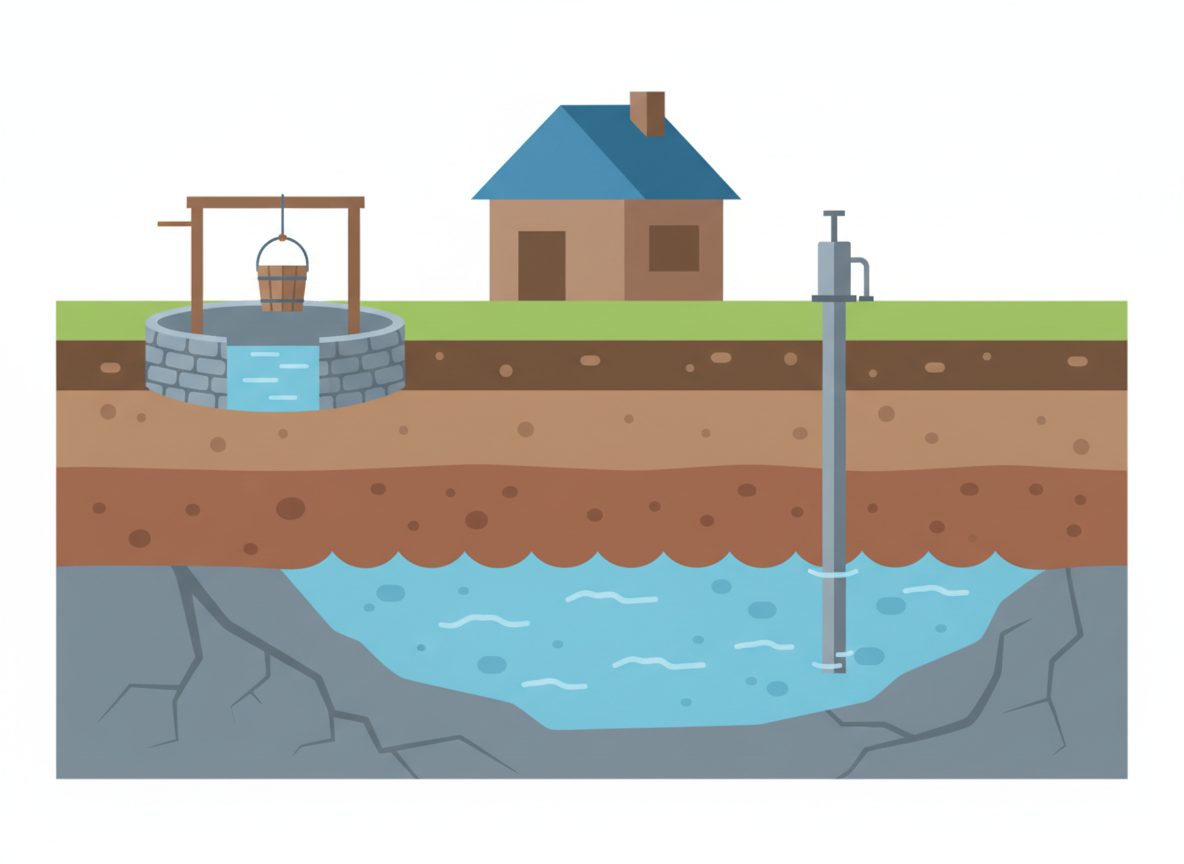
Quick answer: How deep is a well? It depends on the type. According to the EPA, dug wells are roughly 10 to 30 feet deep and driven wells roughly 30 to 50 feet, while drilled wells can reach hundreds or even thousands of feet. Most modern home wells are drilled; UMass Extension describes them as typically going 100 to 400 feet into bedrock. Your well’s exact depth is usually listed on its well log.
You are about to shock the well, replace the pump or buy a house in the country, and someone asks, “How deep is it?” You have no idea. By the end of this guide you will know the typical range for your type of well, what decided its depth, and how to find the real number in a few minutes online.
Typical well depths at a glance
State and federal agencies describe three main types of private wells. The depths below are typical ranges, not limits.
| Well type | Typical depth | How it is built | Contamination risk |
|---|---|---|---|
| Dug (or bored) | 10 to 30 feet (EPA, Connecticut DPH) | Dug by shovel or backhoe, lined with watertight material such as precast concrete | Highest, because it is so shallow (Connecticut DPH) |
| Driven | 30 to 50 feet (EPA, Connecticut DPH) | 2- to 3-inch metal pipe driven into sand or gravel | Moderate to high (Connecticut DPH) |
| Drilled | 100 feet or more into bedrock (Connecticut DPH); 100 to 400 feet into bedrock (UMass Extension); can exceed 1,000 feet (USGS) | Rotary or percussion rig, usually about 6-inch casing | Lower, thanks to depth and continuous casing (EPA) |
Regional averages vary a lot. Penn State Extension, for example, says Pennsylvania wells range from less than 10 feet to more than 1,000 feet deep, with the average usually between 100 and 200 feet.
How deep is a well of each type, and why
Dug wells
The USGS explains that dug wells work only where the ground is soft and the water table is shallow. They cannot be dug much deeper than the water table, because the hole keeps filling with water, much like digging at the beach. That shallow depth is why they are the most vulnerable to surface contamination and drought.
Driven wells
A driven well is a small pipe with a screened point pushed into soft sand or gravel. The USGS notes these can tap only shallow water, and because the source is so close to the surface, surface pollutants can get in.
Drilled wells
The USGS says most modern wells are drilled, and they can go more than 1,000 feet deep. Penn State Extension notes the space between the casing and the drill hole should be filled with clay grout or cement, which helps keep surface water from running down the outside of the pipe.
What decides how deep your well needs to be
A driller does not pick a depth in advance. They drill until they reach enough water of acceptable quality, within what local rules allow. Four things shape that:
- The aquifer. Water has to come from a layer of sand, gravel or fractured rock that holds and passes enough water. If the shallow layers are thin or poor, the well has to go deeper.
- The water table. The USGS explains that pumping lowers the water level around a well, forming a cone of depression, and that this cone extends deeper in low-yielding aquifers. The well has to reach far enough below the water level to keep the pump submerged through dry seasons and heavy use.
- Geology. In bedrock, water often moves through fractures, so the driller keeps going until the hole hits enough of them. UMass Extension notes that hydrofracturing can increase a bedrock well’s yield.
- Local code. State and county rules set minimum casing depths, grouting and setbacks (see below). They do not usually set a total well depth, but they can push the casing, and the cost, deeper.
If you are worried about output, our guide to well yield in gallons per minute explains how flow is measured.
Is a deeper well always better?
Not always. A University of Wisconsin-Extension publication, “Do Deeper Wells Mean Better Water?”, sums up the tradeoff with the advice “as shallow as possible, as deep as necessary.” Here is how depth tends to affect water:
| Factor | Shallower water | Deeper water |
|---|---|---|
| Recent human contamination (pesticides, fuel spills, septic) | More likely to reach the well | Less likely, because groundwater moves slowly (the publication estimates about a foot per day) |
| Dissolved minerals (calcium, magnesium, iron, manganese) | Often lower | Often higher |
| Natural radioactivity (radium, uranium, radon) | Generally lower | Found at elevated levels in some deeper wells |
| Corrosive water | Often corrosive, as protective minerals are depleted | Less often corrosive |
| Cost | Lower | Higher: more drilling, casing, wire and pump power |
That UW-Extension publication dates from 1996, but the basic geology has not changed. Depth also does not guarantee safety from natural contaminants. See our guides to arsenic in well water and radon in well water.
Mistake to avoid: Assuming a deep drilled well does not need testing. Depth lowers some risks and raises others, so follow the CDC’s advice to test at least once a year for bacteria and nitrate, plus local natural contaminants. Our well water testing guide lists what to include.
For what each extra foot costs, see our guide to the cost to drill a well.
How to find out how deep your well is
You can usually find the depth without opening the well.
- Look for the well log. Also called a well construction report, well record or driller’s log. Check closing documents if you bought the house.
- Search your state’s well-record database. Many states have one. The Minnesota Well Index lists location, depth, geology, construction and static water level. Wisconsin DNR’s online search returns Well Construction Reports showing drillhole depth and casing depth. Penn State Extension points Pennsylvania owners to the state’s Groundwater Information System.
- Ask the driller who built it. Many keep their own records. In Massachusetts, UMass Extension notes the driller must submit a well completion report within 30 days, and advises owners to get a copy.
- Hire a licensed well professional to measure it. Wisconsin DNR suggests this if you cannot find a report. They can also measure the water level and check the pump.
Pro tip: When you find the log, note the total depth, casing depth, casing diameter and static water level. You will need them to calculate a shock chlorination dose and when a pump is replaced.
Minimum casing depths: examples from state codes
The casing is the pipe that lines the upper part of the well and keeps surface water out. Casing rules are set state by state, and sometimes by county. These examples are for illustration only; check your own state’s current code.
| State | Example requirement | Source |
|---|---|---|
| New York | Casing at least 19 feet below finished grade; if bedrock is within 19 feet, grouted to 19 feet or 5 feet into competent bedrock, whichever is deeper | NY Codes, Title 10, Appendix 5-B |
| North Carolina | Casing seated at least 5 feet into rock for bedrock wells; grouted to at least 20 feet below land surface in most areas | 15A NCAC 02C .0107 |
| Illinois | Where less than 30 feet of soil covers creviced bedrock, casing must reach at least 40 feet below ground | Illinois Department of Public Health |
| Connecticut | Drilled well casing typically at least 20 feet into the ground and 6 inches above final grade | Connecticut DPH |
| Pennsylvania | No statewide construction standards for private wells, other than some county or local ordinances | Penn State Extension |
Frequently asked questions
What is the average depth of a residential well?
There is no single national figure because it depends on local geology. Most household wells today are drilled, and UMass Extension describes drilled wells as typically going 100 to 400 feet into bedrock. In Pennsylvania, Penn State Extension says the average is usually 100 to 200 feet.
How deep is a drilled well compared with a dug well?
A dug well is usually 10 to 30 feet deep, while a drilled well commonly goes 100 feet or more and, according to the USGS, can exceed 1,000 feet.
Can I measure my well’s depth myself?
It is safer to find the well log or hire a licensed well professional. Opening a well can let in contamination, and the pump wiring runs through the wellhead. Turn off the pump’s breaker before anyone opens the cap.
Does a deeper well mean more water?
Not necessarily. Yield depends on how much water the aquifer or rock fractures deliver, not depth alone. Drilling deeper helps only if it reaches more water-bearing layers or fractures. See signs your well is running dry.
Do old dug wells need to be replaced?
Not automatically, but dug wells carry the highest contamination risk according to Connecticut DPH. Test them more often and consider UV treatment or replacement if results are poor.
Related guides
- Cost to drill a well: per-foot prices and full system totals
- Buying a home with a well: inspection and testing checklist
- How to shock a well with bleach (with dose chart)
Sources
- U.S. EPA – Learn About Private Water Wells
- USGS Water Science School – Groundwater Wells
- Connecticut Department of Public Health – Private Wells: Types and Construction
- Penn State Extension – Private Water Systems FAQs
This guide is for general information. Well construction rules vary by state and county; check with your state agency and a licensed well contractor before drilling, deepening or opening a well.
Leave a Reply