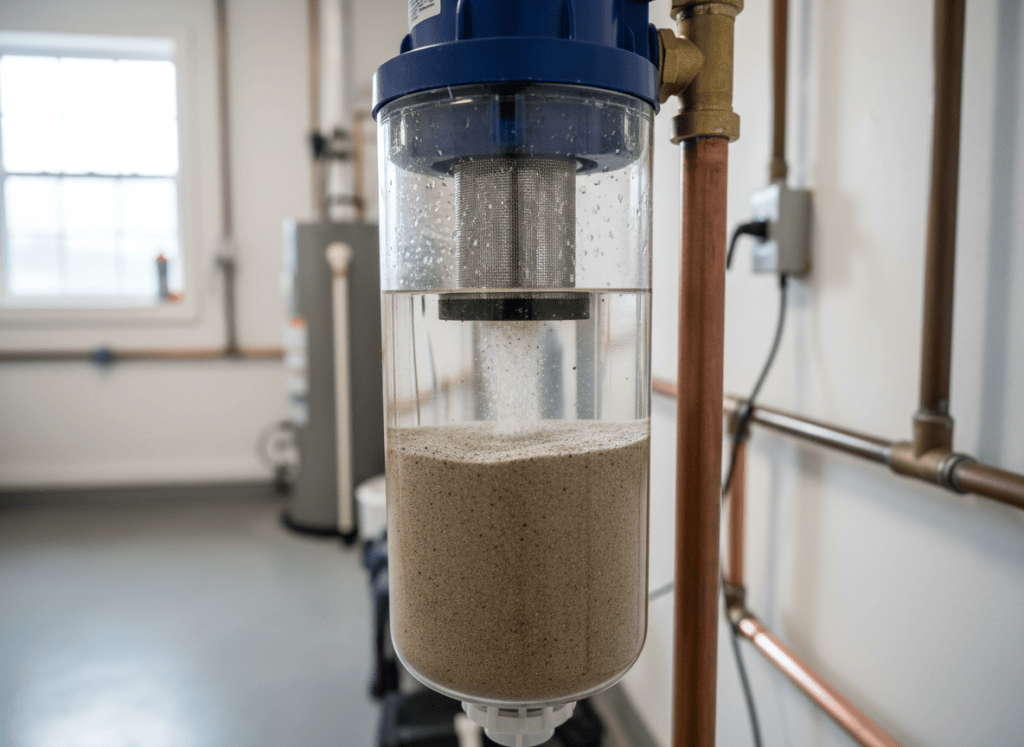
Quick answer: Sand, silt or grit in well water usually comes from the well itself: an aging well screen, a pump set too close to the bottom, a new well settling in, or a falling water table. First work out whether it is a well problem (sudden sand, pump cycling, less water) or a steady, low-level nuisance. A well problem needs a contractor. A steady nuisance is handled with a spin-down filter for sand plus a cartridge filter for fine silt.
Common causes
- Worn or damaged well screen. Common in older wells; holes or corrosion let sand in.
- Pump set too deep. A pump close to the bottom of the well pulls up sediment. An oversized pump can also draw sand through an intact screen.
- New well or recent work. New wells often produce sand or silt for the first few days or weeks.
- Dropping water level. Drought or heavy use can make the pump draw from sandier zones.
- Nearby construction or blasting that disturbs the aquifer.
- Corroded galvanized pipes. Rust flakes from old steel pipe can look like sediment. A clue: it is worse in hot water and clears after running the tap.
- A failing pressure tank. A ruptured bladder causes rapid pump cycling that stirs up sediment (see well pump short cycling).
Three simple tests
The glass test. Fill a clear glass with cold water and watch it settle:
| How it settles | Likely cause |
|---|---|
| Clears within about 5 minutes | Coarse sand (or just air bubbles, which rise to the top) |
| Clears within about an hour | Fine sand or silt |
| Still cloudy after a day | Very fine clay or suspended solids |
The toilet tank check. Lift the tank lid. Sediment on the bottom of the tank means it is coming into the house with the water.
Hot vs cold. If only the hot water is discolored or gritty, the problem is likely sediment in the water heater or corroded pipes after it, not the well. Flushing the water heater often helps.
Well problem or filter problem?
Call a licensed well contractor if:
- Coarse sand suddenly appears, especially in a well more than about 15 years old.
- The pump is cycling on and off rapidly.
- The well is producing less water than before.
- Sand appeared right after a new pump was installed.
A filter is the right fix if:
- The sediment is fine and has been steady over time.
- The well has been checked and is sound.
- You need to protect a softener, UV system or other equipment downstream.
Don’t use a filter to hide a failing well. Filters will clog constantly, and the underlying problem can get worse.
Choosing a sediment filter
| Filter type | Catches | Best for | Maintenance |
|---|---|---|---|
| Spin-down | Coarse sand, typically about 30–100 microns | First stage; protects everything after it | Open the flush valve to empty the bowl; clean the screen |
| Cartridge (e.g. 4.5″ × 20″ “big blue”) | Fine silt, often 5–50 microns | Polishing after a spin-down | Replace cartridges regularly |
| Backwashing filter | Fine sediment, about 5–20 microns | Heavy sediment loads | Self-cleaning; media lasts years |
A micron is a thousandth of a millimeter; a human hair is roughly 75 microns wide.
A common setup: a spin-down filter near where water enters the house, followed by a cartridge filter. Going from coarse to fine keeps the fine cartridge from clogging in days. Install sediment filters before a water softener or UV system, since sediment can foul resin and shield bacteria from UV light.
When cloudy water is a warning sign
Stop drinking the water and test for bacteria if:
- Sudden cloudiness comes with stomach illness in the household.
- Sediment appears after flooding or heavy rain.
- Discolored water also has an unusual smell.
Frequently asked questions
Is sediment in well water harmful?
Sediment itself is mostly a nuisance, but it can damage appliances and shield bacteria. Sudden changes after rain or flooding should be tested.
What micron sediment filter is best for well water?
Start coarse and go finer: a spin-down for sand, then a cartridge in the 5–20 micron range for silt. Going straight to a very fine filter makes it clog quickly.
Why is my new well producing sand?
New wells often produce sand for a few days or weeks while they settle. If it continues, ask the driller to check the well.
Will a sediment filter remove iron?
Only iron that has already turned into rust particles. For dissolved iron, see our guide to iron in well water.
Related guides
- Iron in well water: orange stains and the right filter
- Well pump short cycling: causes and fixes
- UV water treatment for well water
Sources
- Mid Atlantic Water – Sand in Well Water: Causes, Fixes & Filters
- Fresh Water Systems – How a Spin-Down Filter Works
This guide is for general information. Have a licensed well contractor inspect the well if sediment appears suddenly.


Leave a comment