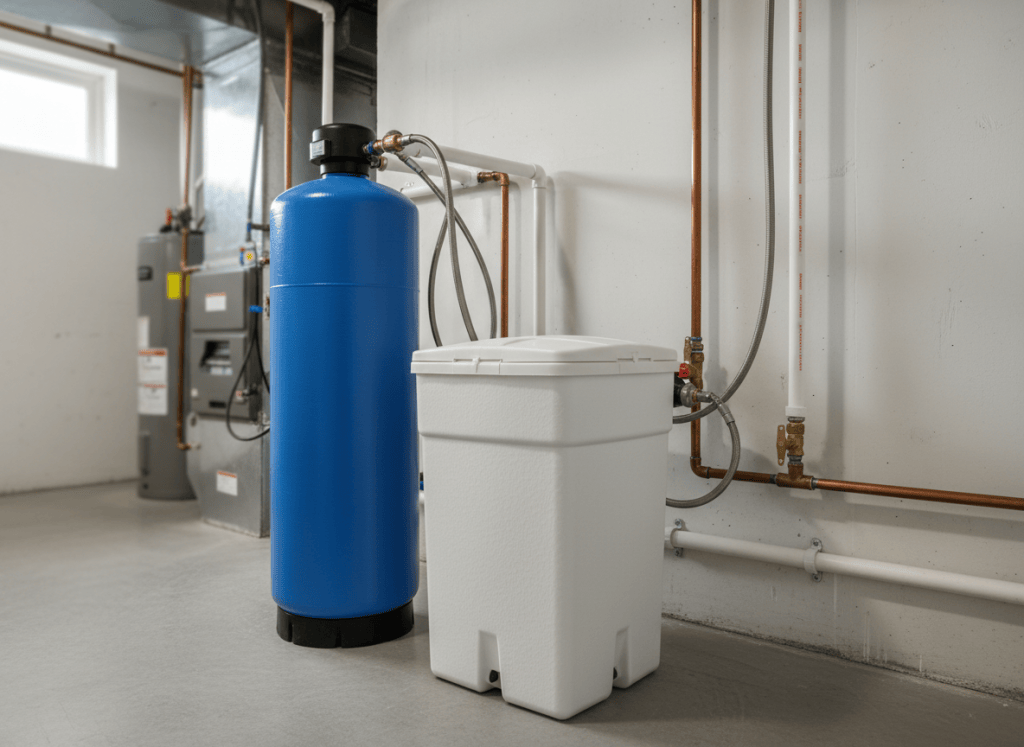
Quick answer: Multiply the number of people in your home by 75 gallons, then by your water hardness in grains per gallon (gpg). That is how many grains the softener removes each day. Multiply by 7 for a week, add a safety margin, and pick the next size up. A family of four with 10 gpg water needs about 21,000 grains a week, so a 32,000-grain softener is a comfortable fit. On well water, add 5 gpg for every 1 ppm of iron before you do the math.
Getting the size right matters. A softener that is too small regenerates too often, wasting salt and water and wearing out faster. One that is too large costs more up front and can let water sit too long in the resin.
Step 1: Find your water hardness
Hardness is measured in grains per gallon (gpg) or parts per million (ppm, the same as mg/L).
- On well water, you need your own test. A home test strip gives a rough number; a state-certified lab gives an accurate one and also measures iron, which you need for step 3.
- Converting: if your result is in ppm, divide by 17.1 to get gpg. For example, 200 ppm ÷ 17.1 = 11.7 gpg.
Step 2: Estimate your daily water use
The industry standard is 75 gallons per person per day.
| People | Gallons per day |
|---|---|
| 1 | 75 |
| 2 | 150 |
| 3 | 225 |
| 4 | 300 |
| 5 | 375 |
| 6 | 450 |
If you have a large garden, livestock, a hot tub, or unusually long showers, estimate higher.
Step 3: Adjust for iron (well water)
Iron takes up space on the softener resin just like hardness. To account for it, sizing guides use compensated hardness:
Compensated hardness = hardness (gpg) + 5 × iron (ppm)
Example: 15 gpg hardness and 2 ppm iron = 15 + (5 × 2) = 25 gpg.
A standard softener only handles a limited amount of dissolved (“clear water”) iron. Check the manufacturer’s iron limit. If your iron is above it, or you see orange particles in the water, you need a dedicated iron filter ahead of the softener, not just a bigger softener.
Step 4: Do the math
Weekly grains = people × 75 gallons × compensated hardness × 7 days
Then choose a softener rated above that number. We recommend at least a 20% margin so the unit is not running at its limit, and to cover visitors and heavy-use days.
Worked examples
| Household | Hardness | Iron | Compensated hardness | Grains per week | Suggested size |
|---|---|---|---|---|---|
| 2 people | 10 gpg | 0 | 10 gpg | 10,500 | 24,000 |
| 4 people | 10 gpg | 0 | 10 gpg | 21,000 | 32,000 |
| 3 people (well) | 12 gpg | 2 ppm | 22 gpg | 34,650 | 48,000 |
| 4 people (well) | 15 gpg | 2 ppm | 25 gpg | 52,500 | 64,000 |
| 5 people (well) | 20 gpg | 1 ppm | 25 gpg | 65,625 | 80,000 |
The 4-person, 10 gpg home is worth a closer look: 21,000 grains a week technically fits a 24,000-grain unit, but with almost no margin. A 32,000-grain softener is the safer choice.
Water softener sizing chart
Based on 75 gallons per person per day, weekly regeneration and a 20% margin. Use your compensated hardness if you have iron.
| People | 5 gpg | 10 gpg | 15 gpg | 20 gpg | 25 gpg |
|---|---|---|---|---|---|
| 1 | 24,000 | 24,000 | 24,000 | 24,000 | 24,000 |
| 2 | 24,000 | 24,000 | 24,000 | 32,000 | 32,000 |
| 3 | 24,000 | 24,000 | 32,000 | 40,000 | 48,000 |
| 4 | 24,000 | 32,000 | 40,000 | 64,000 | 64,000 |
| 5 | 24,000 | 32,000 | 48,000 | 64,000 | 80,000 |
| 6 | 24,000 | 40,000 | 64,000 | 80,000 | 96,000 |
Common residential sizes are 24,000, 32,000, 40,000, 48,000, 64,000 and 80,000 grains. Above about 25 gpg compensated hardness or 6 people, talk to a water treatment specialist; a twin-tank system may make more sense.
Grain rating vs real capacity: the fine print
A softener’s advertised grain number is usually its maximum capacity at the highest salt setting. Many owners set a lower salt dose to save salt, which reduces the real capacity. For example, one retailer’s sizing chart pairs a 32,000-grain unit with a real setting of about 24,000 grains. That is one more reason to leave a margin.
As a rule of thumb, 1 cubic foot of resin is roughly a 32,000-grain softener, so the grain rating also tells you how much resin is in the tank.
Other things to check before you buy
- Flow rate: the softener must keep up with your peak demand (several showers and appliances at once). Larger homes and more bathrooms need a higher flow rating.
- Metered (demand-initiated) valve: regenerates based on actual water used, not a timer. It saves salt and water compared with a fixed schedule.
- Other problems in your water: a softener does not fix bacteria, a rotten egg smell or high iron. Solve those first. See why well water smells like rotten eggs.
- Bypass valve: lets you send untreated water to outdoor faucets and makes maintenance or a well shock treatment easier.
Frequently asked questions
Is a bigger water softener always better?
No. An oversized unit costs more and regenerates less often, which can leave water sitting in the resin for long periods. Size to your needs plus a sensible margin.
What size water softener for a family of 4?
For typical hardness of 10 gpg with no iron, a 32,000-grain softener. For hard well water (15–20 gpg) or water with iron, you will likely need 40,000 to 64,000 grains. Use the formula above with your own test numbers.
How often should a water softener regenerate?
Sizing guides aim for about once every 5–7 days. Much more often means it is too small; much less often may mean it is too big.
Can a water softener remove iron from well water?
Small amounts of dissolved iron, yes, which is why iron is included in the sizing. Higher levels, or iron that has already turned to rust particles, need a dedicated iron filter.
Related guides
- Well water smells like rotten eggs? Find the cause and fix it
- How to shock a well with bleach
- Salt-free vs salt-based water softener
Sources
- Lowe’s – Water Softener Sizing Chart
- Discount Water Softeners – Water Softener Sizing Chart
- SoftPro – Residential Water Softener Capacity Explained
- Mid Atlantic Water – What Size Water Softener Do I Need?
Sizing charts are a starting point. For hard well water with iron, manganese or sulfur, get a lab test and a professional recommendation before buying.


Leave a comment