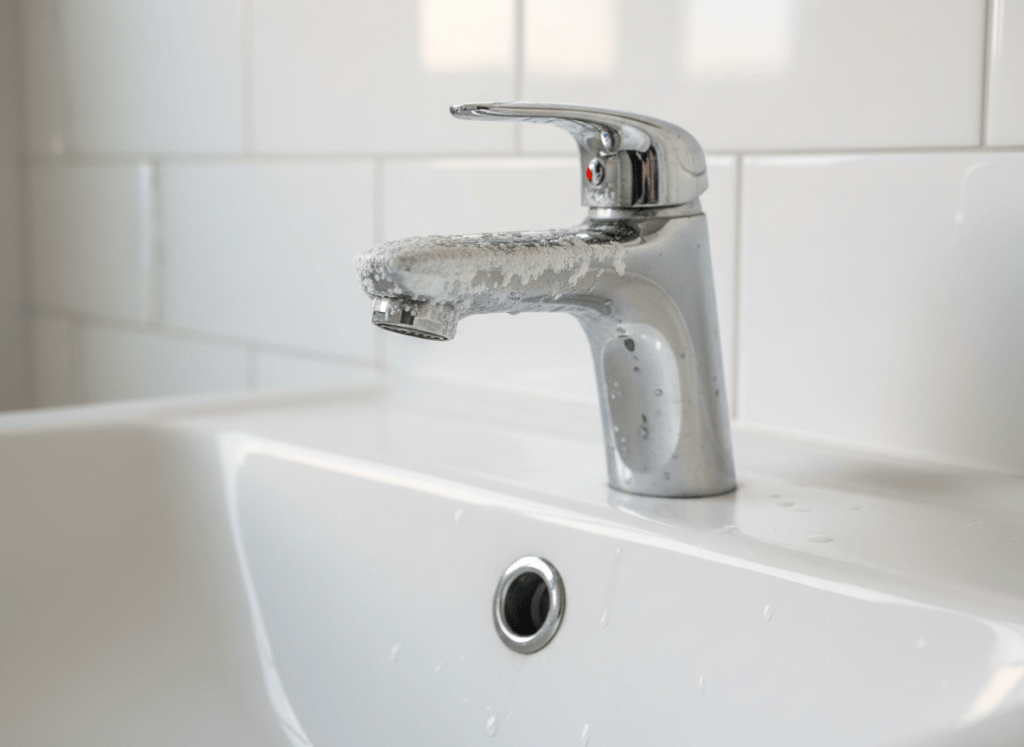
Quick answer: A salt-based softener removes hardness minerals from the water, so your test result actually goes down. A salt-free “softener” (usually a TAC conditioner) removes nothing; it changes the minerals so they are less likely to form scale. Salt-free systems can work for scale prevention on moderately hard water, but they are easily fouled by iron, manganese and sediment, which are common in well water. For most wells with iron or very hard water, a salt-based softener (with pre-treatment if needed) is the more reliable choice.
How each one works
Salt-based softener (ion exchange). Water flows through resin beads that trade calcium and magnesium for sodium (or potassium). When the resin is full, the softener rinses it with salt brine and flushes the hardness down the drain. Result: truly soft water, a lower hardness number, better soap lather and that “slippery” feel.
Salt-free conditioner (template-assisted crystallization, TAC). Water passes over media that turns dissolved hardness into microscopic crystals. The crystals stay suspended in the water and are less likely to stick to pipes and heaters. The minerals are all still there, and the hardness number does not change.
What independent testing found
A study for the WateReuse Research Foundation with Arizona State University evaluated TAC using the German DVGW W512 test and found roughly 88–99% scale reduction at the technology level. Certification standards set the bar at:
- DVGW W512: at least 80% scale reduction
- IAPMO/ANSI Z601: at least 70% scale reduction
Two important caveats: certification applies to specific products, not every salt-free system on the market, and “scale reduction” is not the same as “soft water.” Look for a product certified to one of these standards.
Side-by-side comparison
| Salt-based softener | Salt-free (TAC) conditioner | |
|---|---|---|
| Removes hardness? | Yes | No |
| Prevents scale? | Yes | Mostly, if water is suitable |
| Soap lather / “soft” feel | Yes | No |
| Handles iron? | Small amounts of dissolved iron | No: iron fouls the media |
| Sensitive to manganese, sediment? | Somewhat | Very |
| Uses salt | Yes | No |
| Drain and electricity | Needs both | Usually neither |
| Adds sodium to water | A small amount | No |
| Maintenance | Refill salt; occasional cleaning | Replace media every few years |
Why well water complicates salt-free systems
According to the independent reviews above, TAC media struggles with:
- Iron and manganese, which coat the media and stop it working
- Sediment
- Very high hardness
- Very hot water, where scale forms more easily
Many private wells have at least one of these. If your lab test shows iron or manganese, you would need to remove them first with an iron filter, and at that point a salt-based softener is often the simpler system.
Which should you choose?
Choose salt-based if:
- Your water has iron (even a little), or hardness is high.
- You want truly soft water: better lather, no spots, softer laundry.
- You have space for a brine tank and a drain nearby.
Salt-free can make sense if:
- Your only problem is moderate hardness and your goal is protecting the water heater and fixtures from scale.
- Your water has no iron, manganese or sediment (confirmed by a lab test).
- You can’t discharge brine (some areas restrict it) or you’re on a low-sodium diet.
If you go with a salt-based softener, size it correctly with our water softener size calculator guide.
Frequently asked questions
Do salt-free water softeners really work?
Certified TAC systems can reduce scale significantly in suitable water. They do not soften water, and they are not a good fit for water with iron or manganese.
Will a salt-free system remove iron from well water?
No. Iron damages TAC media. Treat iron separately.
Does a salt-based softener make water salty?
It adds a small amount of sodium, depending on your hardness. People on sodium-restricted diets can use potassium chloride instead of salt or drink from a reverse osmosis tap.
Can I test whether a salt-free system is working?
Not with a hardness test strip, because hardness doesn’t change. You judge it by scale buildup over time.
Related guides
- What size water softener do I need?
- Iron in well water: orange stains and the right filter
- Reverse osmosis for well water
Sources
- TapWaterData – Salt-Free Water Softeners: What TAC Actually Does
- Penn State Extension – Iron and Manganese in Private Water Systems
This guide is for general information. Base equipment choices on a lab test of your own water.


Leave a comment