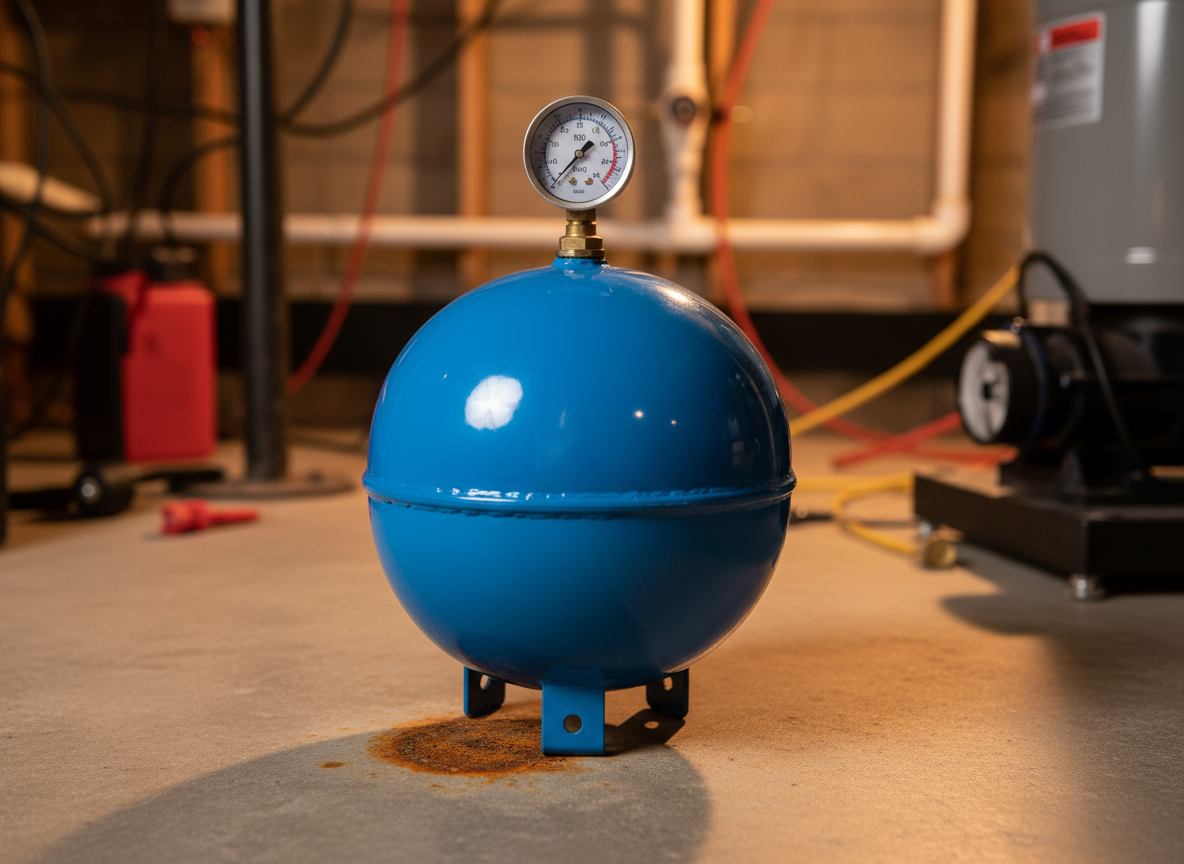
Quick answer: The main signs of a bad pressure tank are short cycling (the pump clicking on and off every few seconds), pressure that swings in the shower, water coming out of the air valve, a tank that sounds full from top to bottom when you tap it, and rust or leaks on the shell. To confirm, turn off the pump, drain the tank and check the air charge at the valve. Water from the valve means a failed bladder and, on most tanks, a replacement.
A failing tank quietly wears out the pump and pressure switch long before the tank itself gives up.
What a pressure tank does
A pressure tank holds a cushion of compressed air, usually separated from the water by a rubber bladder or diaphragm. The air pushes water out when you open a tap, so the pump doesn’t start for every glass.
The University of Nebraska–Lincoln Extension explains what happens when that air cushion is lost: there is little air left to compress, so the pump runs nearly every time water is used. That constant starting is what makes a bad tank expensive.
Signs of a bad pressure tank
| Symptom | What it usually means | How to confirm |
|---|---|---|
| Short cycling: pump clicks on and off every few seconds while water runs | Waterlogged tank or low air charge | Air valve test and air charge check (below) |
| Pressure swings in the shower or at taps | Too little air cushion, so pressure rises and falls quickly | Watch the gauge while a tap runs |
| Water sprays from the air valve | Ruptured bladder or diaphragm | Press the valve pin with the pump off |
| Tank sounds dull or “full” all the way up when tapped | Waterlogged tank | Knock test |
| Rust, bulging, weeping seams or leaks | Corroded shell nearing end of life | Visual check; replace, don’t recharge |
| Tank keeps losing air after you recharge it | Leaking air valve, shell or bladder | Recheck the charge after a few weeks |
Short cycling and pressure swings
With a bad tank, the gauge needle jumps quickly between cut-in and cut-out, and you feel it as pressure surging and fading in the shower. Our guide to well pump short cycling walks through the other causes, such as a leaking check valve, so you can rule them out.
Water from the air valve
The air valve on top of the tank looks like a tire valve (a Schrader valve). With the pump off, press the center pin briefly. Air should come out. If water sprays out, the bladder or diaphragm has failed and water has reached the air side of the tank.
The knock test
Tap the tank with your knuckles from top to bottom. The Well Guide explains that a healthy tank sounds hollow in the upper part (air) and solid lower down (water). A tank that sounds uniformly solid from top to bottom is waterlogged. The Well Guide also notes that a waterlogged tank can feel abnormally heavy.
Rust and leaks
The tank is a pressure vessel. Amtrol’s tank manual warns that tanks can corrode, weaken and burst over time, and says not to adjust the precharge if there is visible exterior corrosion. A rusted, dented or leaking tank should be replaced, not recharged.
How to test a pressure tank
You’ll need a tire pressure gauge and an air compressor or bike pump. This matches the steps in our pressure tank air pressure guide.
- Turn off the power to the pump at the breaker.
- Drain the tank. Open a faucet near the tank, or the tank’s drain valve, and let it run until water stops and the pressure gauge reads zero.
- Remove the cap from the air valve.
- Press the pin briefly. Water means a failed bladder; stop here and plan a replacement.
- Measure the air charge with the tire gauge.
- Compare it to your cut-in pressure. Amtrol’s manual says to set the precharge 2 psi below the pressure switch cut-in. That’s 28 psi for a 30/50 switch and 38 psi for a 40/60 switch.
- Adjust by adding or releasing air, then close the faucet, restore power and watch the pump through a full cycle.
Not sure of your cut-in? Watch the gauge as you run water: the pressure where the pump turns on is the cut-in. See well pump pressure switch settings.
| What you find | What it means | Next step |
|---|---|---|
| Water from the air valve | Failed bladder or diaphragm | Replace the tank on most models |
| Air charge at cut-in minus 2 psi | Air charge is fine | Look at the switch, check valve or plumbing |
| Air charge low, air only | Normal slow loss or a small air leak | Recharge and recheck in a few weeks |
| Air charge drops again soon after recharging | Air leak at the valve, shell or bladder | Have it checked; often a replacement |
| Visible rust, dents or weeping | Weakened shell | Replace the tank; don’t add air |
Amtrol recommends having a licensed professional check the complete system, including the tank, yearly, and more often as it ages.
Waterlogged bladder tank vs. old galvanized tank
The fix for a waterlogged tank depends on the type.
| Feature | Bladder or diaphragm tank | Galvanized steel tank (no bladder) |
|---|---|---|
| Air and water | Kept apart by a bladder or diaphragm | In direct contact |
| Why it waterlogs | Bladder ruptures or air leaks out | Water gradually absorbs the air |
| Usual fix | Recharge if the bladder is intact; replace if it failed | Drain to let air back in; check any air control device |
Bladder and diaphragm tanks
UNL Extension notes that in these tanks the water never touches the steel, so no air injection or air release device is needed. If the bladder is intact, top up the air. If water comes from the air valve, the bladder has failed, and on most modern tanks that means replacing the tank.
Galvanized steel tanks
Older galvanized tanks, which UNL Extension describes as common before about 1970, have no bladder. Air and water are in direct contact, and because water absorbs some of the air, the air must be replaced or the tank becomes waterlogged. Some steel tanks have a floating wafer between air and water, and UNL says these still need to be recharged with air every 6 to 12 months.
InspectApedia describes draining as the usual way to restore air in a bladderless steel tank: turn off power to the pump, drain all the water out through the tank drain so air can take its place, close the drain and restore power. It stresses that this method is for bladderless tanks only. Bladder tanks don’t normally need makeup air, and their problems are usually a failed bladder.
If a galvanized tank waterlogs again soon after draining, its air control device may have failed. Many owners switch to a bladder tank at that point. Size it for your pump: UNL suggests multiplying the pump’s flow rate in gallons per minute by four to find the bladder tank size in gallons.
Repair or replace?
| Situation | Repair or replace? |
|---|---|
| Air charge low, no water from the valve, no rust | Repair: recharge the air |
| Water from the air valve | Replace the tank (most bladders aren’t replaceable) |
| Rust, dents, bulging or leaks on the shell | Replace the tank |
| Galvanized tank that waterlogs after draining | Service the air control, or replace with a bladder tank |
| Tank too small for the pump, cycles short with correct air | Replace with a properly sized tank |
Handy homeowners often swap a tank themselves with the power off and the system drained, following the manufacturer’s instructions. Otherwise hire a pump installer, and have the pump and switch checked if the tank short cycled for months.
How long does a pressure tank last?
There is no official figure, and sources disagree. The Well Guide says quality bladder tanks typically last 10 to 15 years under normal conditions, and budget tanks about 5 to 8 years. InspectApedia offers a rough estimate of 10 to 20 years for bladder tanks, while noting that some sources quote as little as 5 to 7. For galvanized tanks, InspectApedia has seen failures in five years with aggressive water and well-coated older tanks lasting 25 years or longer.
Water chemistry, cycling and a correct air charge matter more than age, so judge a tank by the tests above.
Frequently asked questions
How do I know if my pressure tank is bad?
The most reliable sign is water coming out of the air valve when you press the pin with the pump off. Short cycling, pressure swings and a tank that sounds full from top to bottom are also strong clues.
Can a bad pressure tank damage my well pump?
Yes. A waterlogged tank makes the pump start far more often, which overheats the motor and wears out the switch.
Can I just add air to a waterlogged pressure tank?
Only if the bladder is intact, meaning air, not water, comes from the valve. If water comes out, adding air won’t last. For galvanized tanks without a bladder, draining the tank is the usual fix.
Can a bad pressure tank cause low water pressure?
It usually causes pressure swings rather than steady low pressure. If pressure is always low, see low water pressure from a well. A pump that won’t stop is a different problem; see well pump won’t shut off.
Related guides
- Pressure tank air pressure: how to check and set it
- Well pump short cycling: causes and fixes
- Well pump pressure switch settings: 30/50 vs 40/60
Sources
- University of Nebraska–Lincoln Extension – Private Drinking Water Wells: The Distribution System (G2152)
- Amtrol – Well-X-Trol Installation, Operation and Maintenance Manual
- The Well Guide – Well Pressure Tank: The Complete Guide for Private Well Owners
- InspectApedia – Water Pressure Tank Age and Life Expectancy
This guide is for general information. Pressure tanks are pressurized vessels; turn off the pump and drain the tank before any work, follow the manufacturer’s instructions, and call a licensed pump installer if in doubt.
Leave a Reply