Quick answer: A reverse osmosis (RO) system pushes water through a very fine membrane that holds back most dissolved contaminants, including arsenic, nitrate, lead, radium and many salts. It’s usually installed under the kitchen sink for drinking and cooking water. RO does not remove dissolved gases such as hydrogen sulfide, some pesticides and solvents, and it shouldn’t be relied on for bacteria. It also sends a lot of water down the drain and needs pre-treatment on most well water.
How reverse osmosis works
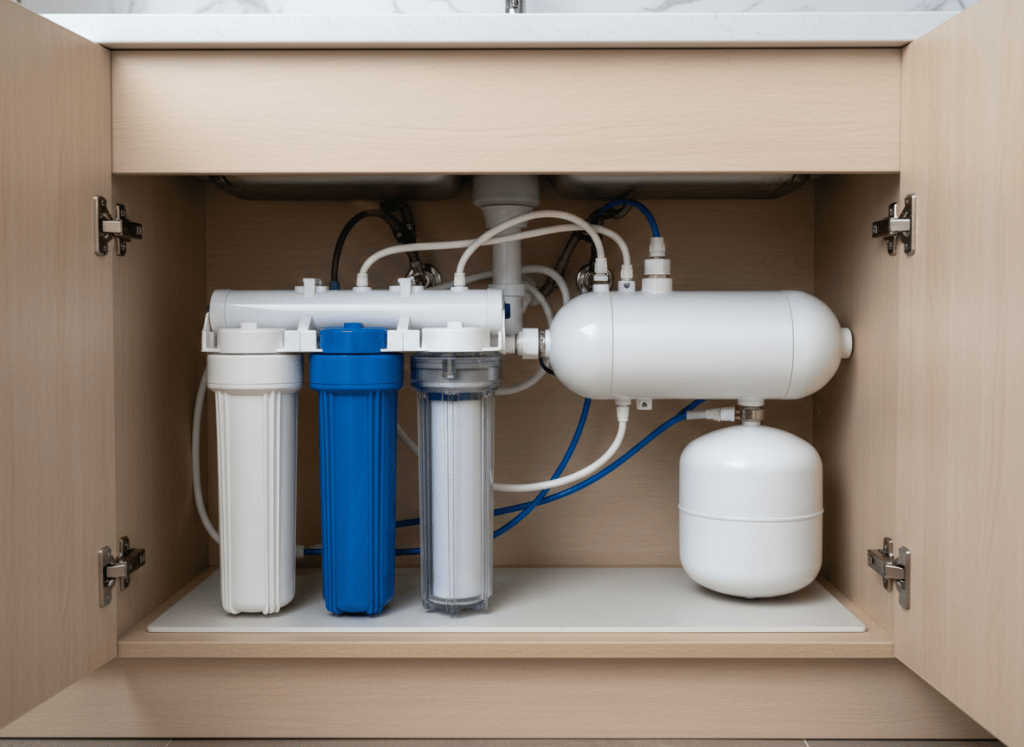
Water pressure pushes water through a semi-permeable membrane. Clean water passes through; most dissolved minerals and contaminants are rejected and flushed to the drain. A typical under-sink system has several stages:
- Sediment pre-filter: catches particles that would clog the membrane.
- Carbon pre-filter: removes chlorine and some organics that damage the membrane.
- RO membrane: the main treatment step.
- Storage tank: holds treated water, because the membrane is slow.
- Carbon post-filter: polishes taste before the faucet.
University of Nebraska–Lincoln Extension notes that household units typically produce 10–35 gallons per day.
What RO removes
According to UNL Extension, RO can reduce:
| Type | Examples |
|---|---|
| Metals and ions | Arsenic, lead, nitrate, cadmium, mercury, radium, selenium |
| Particles | Asbestos, Cryptosporidium |
| Some pesticides | Endrin, lindane, pentachlorophenol |
| Minerals | Hardness, sodium, total dissolved solids |
Removal is a percentage, not 100%. For example, Penn State Extension reports RO removes about 83–92% of nitrate. With very high starting levels, the treated water can still be over the limit, so test the water from the RO faucet after installing it. See nitrate in well water.
What RO doesn’t remove
- Dissolved gases, including hydrogen sulfide (the rotten egg smell).
- Some pesticides, solvents and volatile organic chemicals (VOCs). A good carbon stage helps with some of these.
- Bacteria and viruses, reliably. Membranes can have tiny defects and the storage tank can grow bacteria. If your well has a bacteria problem, fix and disinfect it, or add UV treatment.
How much water does RO waste?
UNL Extension says most household RO systems recover only 20–30% of the water they process. At 20% recovery, making 20 gallons of drinking water sends about 80 gallons to the drain. That’s manageable for drinking water only, which is why whole-house RO is rare and costly.
On a well, all that reject water also runs your pump and goes to your septic system, so keep RO to the kitchen tap unless a professional designs a larger system.
Pre-treatment for well water
Well water often needs treatment before an RO system to protect the membrane:
| Problem | Why it matters | Fix before RO |
|---|---|---|
| Hardness | Scales the membrane | Water softener |
| Iron and manganese | Foul the membrane | Iron filter |
| Sediment | Clogs pre-filters fast | Sediment filter |
| Bacteria | Grows in the unit | Fix the well, shock chlorinate, UV |
Maintenance
- Replace pre- and post-filters on the manufacturer’s schedule.
- Replace the membrane when output drops or test results rise.
- Sanitize the system periodically to prevent bacterial growth.
- Test the treated water at least once a year for the contaminant you bought it for.
Frequently asked questions
Is reverse osmosis good for well water?
Yes, for specific health contaminants like arsenic, nitrate or lead, as long as the water is pre-treated for hardness, iron and sediment.
Does reverse osmosis remove bacteria from well water?
Don’t rely on it. Disinfect the well and use UV if bacteria is a recurring problem.
Can I use RO for the whole house?
It’s possible but expensive to buy and run, and wastes a lot of water. Most homes use RO only at the kitchen sink.
Does RO remove the rotten egg smell?
No. Hydrogen sulfide is a gas and passes through the membrane.
Related guides
- Nitrate in well water: safe levels and treatment
- UV water treatment for well water
- Well water testing: what to test for
Sources
- University of Nebraska–Lincoln Extension – Drinking Water Treatment: Reverse Osmosis (G1490)
- Penn State Extension – Nitrates in Drinking Water
This guide is for general information. Test your water and choose equipment certified for the contaminant you need to remove.


Leave a comment