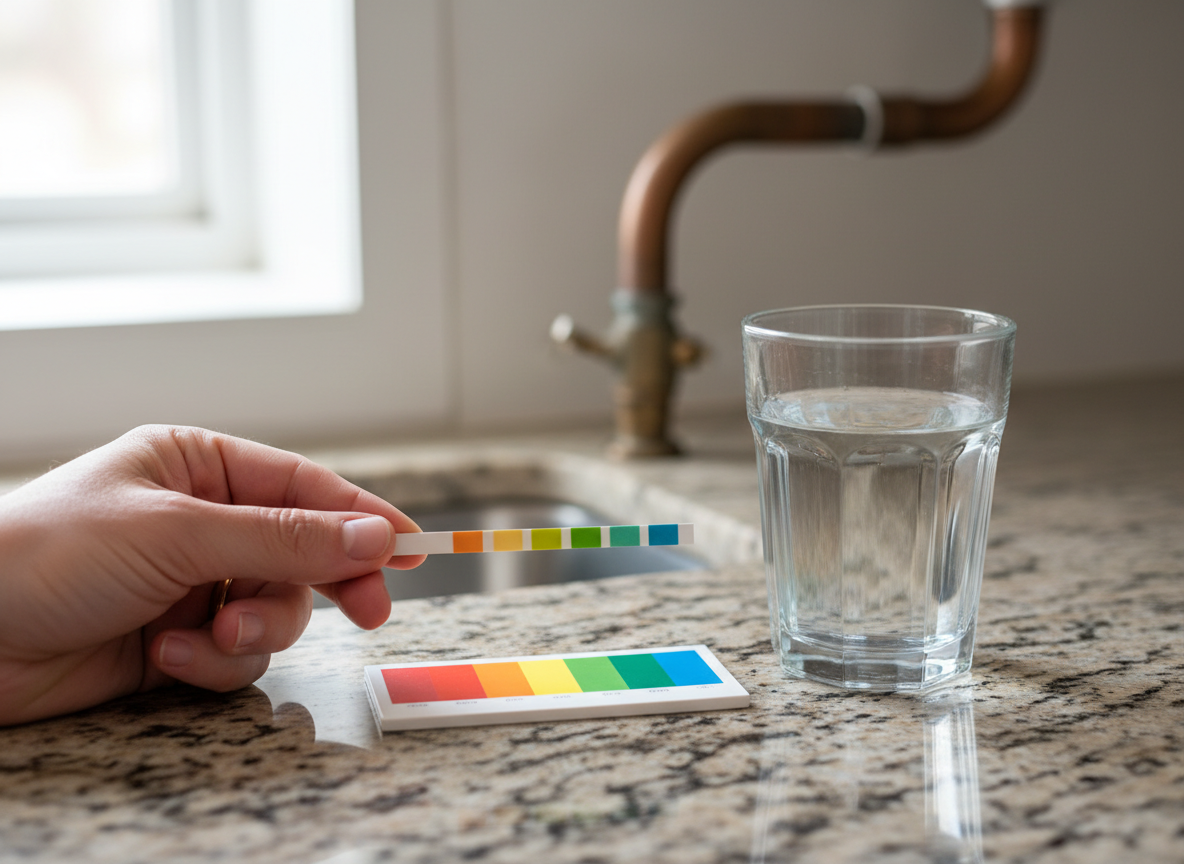
Quick answer: The EPA recommends a pH between 6.5 and 8.5 for drinking water. Well water below 6.5 is acidic and corrosive: it can leave blue-green stains, cause a metallic taste, eat through copper pipes and dissolve lead and copper into your water. Water above 8.5 causes scale and a soda-like taste but is not a direct health risk. Most homes fix low pH with a calcite acid neutralizer, or a soda ash feed for very acidic water.
pH itself is rarely the problem. What matters is what acidic water does to your plumbing, and what it picks up along the way. That is why pH is one of the first numbers to check on any well test.
The pH scale in plain terms
pH runs from 0 to 14, with 7 as neutral. Below 7 is acidic; above 7 is alkaline (basic).
The scale is logarithmic. Virginia Cooperative Extension explains that water at pH 6.0 is 10 times more acidic than water at pH 7.0, and water at pH 5.0 is 100 times more acidic. A reading that looks only slightly low can mean much more corrosive water.
| pH reading | What it means | Typical concern |
|---|---|---|
| Below 6.5 | Acidic | Corrosion, metal leaching, blue-green stains |
| 6.5 to 8.5 | EPA recommended range | Generally no pH-related problems |
| Above 8.5 | Alkaline | Scale, soda taste, slippery feel |
The EPA range is a secondary standard. According to the EPA, secondary standards are non-enforceable guidelines for aesthetic effects like taste, staining and corrosion. For a private well, no one enforces them, but they are still the best target.
Signs of low pH (acidic water)
Acidic water is often naturally soft, and it dissolves the metals it touches. The Water Systems Council and the EPA list these warning signs:
- Blue-green stains in sinks, tubs and toilets. This is dissolved copper from your pipes. The EPA ties blue-green staining to copper in water.
- A bitter or metallic taste. The EPA lists this as the noticeable effect of low pH.
- Stained laundry.
- Leaks in copper pipes. Over time, corrosion thins the pipe wall and can cause small pinhole leaks.
- Metals in your water test, such as copper, lead or zinc, even though your well water itself may be clean.
Why lead and copper are the real risk
The biggest health concern with acidic water is not the acid; it is the metal it pulls out of your plumbing. Virginia Cooperative Extension notes that lead can harm the nervous, cardiovascular, reproductive and kidney systems, and the EPA’s health goal for lead is zero. Copper can cause nausea, vomiting, diarrhea and stomach cramps. The EPA’s health-based goal for copper is 1.3 mg/L, and its secondary (taste and staining) standard is 1.0 mg/L.
Older homes with lead solder, brass fixtures or lead service parts are most at risk. Connecticut’s Department of Public Health notes that metal levels are highest in water that has sat in the pipes, which is why testing for them is done differently (see below).
Signs of high pH (alkaline water)
High pH is less common in wells and less serious. According to the Water Systems Council and the EPA, water above 8.5 can cause:
- A slippery feel and a soda or alkali taste
- Bitter-tasting coffee
- Scale deposits in pipes, fixtures and appliances
- Lower water heater efficiency from scale buildup
The Water Systems Council says high pH poses no direct health risk. It usually signals a high level of alkalinity minerals in the water.
How to test well water pH
- Get a lab test with general chemistry. A state-certified lab can measure pH along with hardness, alkalinity, iron, copper and lead. These results together tell a dealer which treatment will work. See our well water testing guide for what to include.
- Use a home kit for quick checks. pH strips and meters are useful to watch for changes between lab tests or to check a neutralizer. See how to test well water at home for their limits.
- Test for lead and copper with a first-draw sample if your pH is low. Connecticut DPH advises collecting the sample after water has sat unused for at least 6 hours, without running any water first. This captures the worst-case metal levels.
- Retest yearly. The Water Systems Council recommends monitoring pH annually once you know your level.
Until you treat: Connecticut DPH suggests running the cold water for about 1 minute before drinking or cooking if the water has sat for 6 hours or more, but only if a flushed sample shows much lower copper than the first draw. Always use cold water for drinking and cooking.
How to fix low pH
The right system depends mostly on how acidic your water is. Here is how the options compare, based on guidance from Extension (drinking-water.extension.org), Virginia Cooperative Extension and the Water Systems Council:
| Treatment | Best for | How it works | Trade-offs |
|---|---|---|---|
| Calcite (calcium carbonate) neutralizer | Mildly acidic water, pH above 6 | Water flows through a tank of crushed calcite, which dissolves slowly and raises pH | Adds hardness; media must be refilled; needs backwashing |
| Calcite + magnesium oxide blend (Corosex is a common brand of magnesium oxide) | More acidic water, below pH 6 | Magnesium oxide handles more acidic water than calcite alone | Adds hardness; media must be refilled |
| Soda ash injection (chemical feed pump) | Very acidic water, as low as pH 4 | A pump feeds a soda ash solution into the water, usually with a retention tank (often about 40 gallons) | Adds a small amount of sodium; pump and solution tank need regular service |
A few practical notes:
- Virginia Cooperative Extension says neutralizing filters can treat water with pH as low as 5.3 and are installed at the point of entry, so all water in the house is treated.
- Extension guidance for neutralizing filters calls for a media bed about 32 to 36 inches deep and a flow rate of no more than 3.0 gallons per minute per square foot of tank area. A properly sized tank matters; an undersized one lets water pass through too fast.
- Because calcite and magnesium oxide add hardness, many homes need a water softener after the neutralizer.
- The Water Systems Council notes that soda ash slightly raises sodium, which may matter for anyone on a low-sodium diet.
- Virginia Cooperative Extension suggests setting the water heater no higher than 140°F, since hot water is more corrosive.
Should the neutralizer go before other equipment? The order matters when you also have problems like iron or manganese, so ask your installer to review your full lab test before sizing or placing anything.
How to fix high pH
Treatment for high pH is less common. Extension guidance describes acid injection, which feeds a weak food-grade acid such as acetic or citric acid to bring pH down toward 7. The Water Systems Council also mentions special ion exchange units. Water at pH 11 or higher needs special handling. Because high pH is mostly a scale and taste issue, many owners address the symptoms with a softener instead.
Testing after treatment
A neutralizer is not a set-and-forget system. Media dissolves, pumps drift and solution tanks run low.
- Check pH after installation to confirm the treated water is in the 6.5 to 8.5 range, both before and after the tank.
- Retest lead and copper with a first-draw sample a few weeks after installation to confirm metal levels have dropped.
- Check pH regularly with a home kit, and refill calcite or magnesium oxide when the bed gets low. A falling reading is often the first sign the media is used up.
- Get a full lab test yearly, including pH, hardness and metals.
Frequently asked questions
Is low pH well water safe to drink?
The acidity itself is not usually the danger. The risk is that acidic water dissolves lead and copper from your plumbing. Test for both with a first-draw sample. If they are low, the main concern is damage to your pipes and fixtures.
What causes low pH in well water?
It usually comes from the local geology rather than contamination. Connecticut DPH notes that the state’s groundwater is naturally acidic, which raises corrosion risk in copper plumbing.
Will a water softener raise pH?
No. A standard softener removes hardness minerals but does not neutralize acidity. You need a neutralizer or a chemical feed system.
How much does an acid neutralizer raise pH?
It depends on the starting pH and the media. Calcite gently brings water toward neutral and is used when pH is above 6. For water below 6, a magnesium oxide blend or soda ash injection is typically needed.
Does acidic water ruin a water heater?
It can shorten its life. Corrosive water attacks metal parts, and Virginia Cooperative Extension recommends keeping the heater at 140°F or lower to limit corrosion.
Related guides
- Well water testing: what to test for and how often
- How to test well water at home
- What size water softener do I need?
Sources
- U.S. EPA – Secondary Drinking Water Standards: Guidance for Nuisance Chemicals
- Virginia Cooperative Extension – Corrosive Household Water
- Extension (drinking-water.extension.org) – Drinking Water Treatment: pH Adjustment
- Connecticut Department of Public Health – Copper in Private Drinking Water Wells
This guide is for general information. Have your water tested by a state-certified lab, including lead and copper, before buying treatment equipment.
Leave a Reply