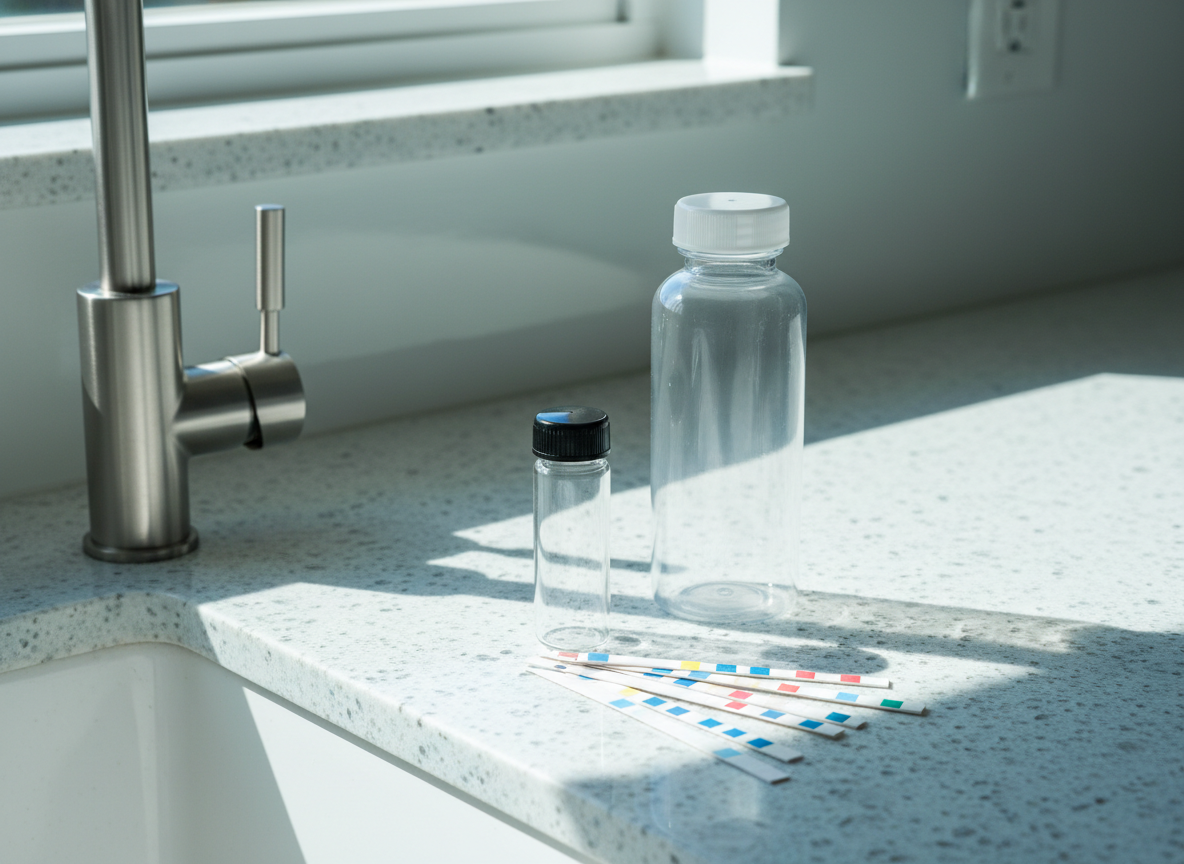
Quick answer: You can test well water at home with test strips or a simple kit for quick checks of hardness, pH and iron. For anything that affects health, such as bacteria, nitrate, arsenic and lead, collect the sample at home but send it to a state-certified laboratory. The CDC, EPA and Penn State Extension all point well owners to certified labs, and the sampling steps below help make sure your results are accurate.
The phrase “testing at home” really covers two things: running a quick test yourself, and collecting a sample yourself for a lab to analyze. Both are useful. Knowing which one fits the question you are asking saves money and avoids false reassurance.
What home test strips and kits are good for
Home strips and color-change kits work best as a screening tool for everyday, non-health questions:
- Hardness. Useful for noticing scale and for a rough starting point before sizing a water softener.
- pH. A quick way to spot acidic water that could be corroding pipes. See well water pH.
- Iron. Helpful for confirming that orange stains are coming from the water. See iron in well water.
- Checking treatment equipment. For example, testing hardness after a softener to confirm it is still working.
These are the same uses our well water testing guide describes: fine for a quick check, not for health decisions.
What home kits cannot reliably tell you
For health-related contaminants, a home result is not something to rely on:
- Bacteria. Home coliform kits exist, but a certified lab uses controlled methods, sterile bottles and strict holding times. A lab report is also what real estate transactions accept.
- Arsenic. The Minnesota Department of Health notes you cannot see, taste or smell arsenic. The drinking water limit is 10 micrograms per liter, a very low level that calls for lab analysis.
- Nitrate. The limit is 10 mg/L as nitrate-nitrogen, and it matters most for infants under 6 months. When a baby’s formula depends on the answer, use a lab.
- Lead. Lead testing requires a specific sampling method and lab analysis.
- Anything you cannot sense. Many contaminants have no color, taste or odor, so “the strip looks fine” does not mean the water is safe.
Penn State Extension advises caution with test results from any uncertified lab or from water treatment salespeople, and recommends that all water tests be performed by a certified laboratory.
Home kit vs. certified lab: side by side
| Home test strips or kits | State-certified lab | |
|---|---|---|
| Best for | Hardness, pH, iron, checking equipment | Bacteria, nitrate, arsenic, lead, full panels |
| Accuracy | Screening level; color matching is subjective | Controlled methods and quality checks |
| Results | Minutes | Usually days |
| Accepted for real estate transactions | No | Yes |
| Useful for health decisions | No | Yes |
| Who collects the sample | You | You, using the lab’s bottle and instructions |
When to use a certified lab
Use a certified lab for the annual baseline the CDC and EPA recommend (total coliform bacteria, nitrate, pH and TDS) and whenever:
- You are buying a home with a well.
- There has been flooding (see well water after a flood).
- The well, pump or plumbing was repaired.
- Taste, color or smell changes.
- Someone in the home is pregnant or you have an infant.
- A home strip shows something unusual and you need a real number.
- You are about to buy treatment equipment. Penn State recommends certified testing before any purchase.
How to find a certified lab
- Start with your county or state health department. The CDC notes they keep lists of certified labs, and the EPA says some local health departments test private wells for free.
- Use the EPA directory. The EPA’s drinking water lab certification page links to each state’s certification program, where you can find labs near you.
- Call the EPA Safe Drinking Water Hotline at (800) 426-4791 if you are stuck.
Order the test from the lab first. They will send the correct bottles, any preservatives and instructions. Never use an old food or drink container.
How to collect a well water sample properly
Most bad results come from bad sampling. Always follow your lab’s instructions first; the steps below reflect Penn State Extension’s guidance.
Before you start
- Check the shipping schedule. Bacteria samples are time-sensitive. Penn State says they should reach the lab within 24 hours, and its own kit allows up to 30 hours. Many labs only accept samples early in the week, so do not sample on a Friday.
- Pick the right tap. For drinking water quality, use the kitchen cold tap. To see what is in the raw well water, use the spigot at the pressure tank, before any treatment equipment.
- Clear any chlorine. If you recently shocked the well, all chlorine must be flushed out before a bacteria sample.
Bacteria sampling protocol
- Remove the aerator (the screen on the faucet tip).
- Disinfect the faucet tip with rubbing alcohol or a flame, as Penn State recommends.
- Run the cold water for about 5 minutes to flush the plumbing.
- Wash your hands or wear clean gloves.
- Open the sterile bottle only at the last moment. Do not touch the inside of the cap or bottle, and do not set the cap down on the counter.
- Do not rinse the bottle. Many bacteria bottles contain a small amount of preservative powder that must stay in.
- Fill to the marked line (often 100 mL) without letting the faucet touch the bottle. Do not overfill.
- Cap tightly, label it and refrigerate until you ship or drop it off.
- Get it to the lab within the time limit.
Chemical samples (nitrate, pH, metals)
Follow the same care, but these bottles usually are not sterile and holding times are longer. Use the bottle and fill instructions the lab provides.
Lead and copper samples
These are the exception to “run the water first.” Penn State says lead and copper need a first-draw sample, taken first thing in the morning after water has sat in the pipes for at least 12 hours, so the test captures what the plumbing adds.
How to read your results
Compare each number to the standard printed on your lab report. These common reference points come from the EPA and state health agencies:
| Test | Reference level | Type of concern |
|---|---|---|
| Total coliform | Should be absent | Health: warning sign of contamination |
| E. coli | Should be absent | Health: fecal contamination |
| Nitrate (as N) | 10 mg/L | Health, especially infants |
| Arsenic | 10 micrograms per liter | Health |
| pH | 6.5 to 8.5 | Corrosion and taste |
| Total dissolved solids | 500 mg/L | Taste, scale, staining |
| Iron | 0.3 mg/L | Staining and taste |
| Manganese | 0.05 mg/L | Black staining and taste |
The pH, TDS, iron and manganese levels are EPA secondary (non-enforceable) standards for taste, color and staining. Hardness has no limit, but Penn State classifies water above 7 grains per gallon as hard and above 10.5 as very hard.
What to do next
- Everything within limits: keep the report and retest next year.
- Coliform or E. coli present: stop drinking untreated water, retest to confirm, and follow our guides to coliform bacteria and shocking a well.
- Nitrate or arsenic above the limit: do not use the water for infant formula, contact your health department, and read our nitrate and arsenic guides. Boiling does not help; it concentrates both.
- Hardness, iron or pH issues: these are mostly nuisance and plumbing problems. See our guide to choosing a whole house water filter for well water.
- A home strip and the lab disagree: trust the lab.
Frequently asked questions
Are home well water test kits accurate?
They are accurate enough for rough screening of hardness, pH and iron. They are not a substitute for a certified lab when the question is whether the water is safe to drink.
Can I test my well water for bacteria at home?
Home bacteria kits exist, but a certified lab is more reliable, and its report is accepted for real estate transactions. You can collect the sample yourself using the lab’s sterile bottle.
How long can a well water sample sit before going to the lab?
For bacteria, Penn State says within 24 hours is recommended, and some labs allow up to 30. Keep the sample refrigerated and check your lab’s exact limit.
Should I run the water before taking a sample?
For bacteria and most chemicals, yes; run cold water for several minutes first. For lead and copper, no; collect a first-draw sample after the water has sat for at least 12 hours.
Is well water testing free?
Sometimes. The EPA notes some local health departments offer free private well testing. Otherwise, you pay a certified lab directly.
Related guides
- Well water testing: what to test for and how often
- Coliform bacteria in well water: what a positive test means
- Buying a home with a well: inspection checklist
Sources
- Penn State Extension – Testing Your Drinking Water
- Penn State Extension – How to Use the Penn State Drinking Water Test Kit
- U.S. EPA – Contact Information for Certification Programs and Certified Laboratories for Drinking Water
- U.S. EPA – Secondary Drinking Water Standards
This guide is for general information. Always follow the sampling instructions from your state-certified laboratory, and contact your health department with questions about your results.
Leave a Reply