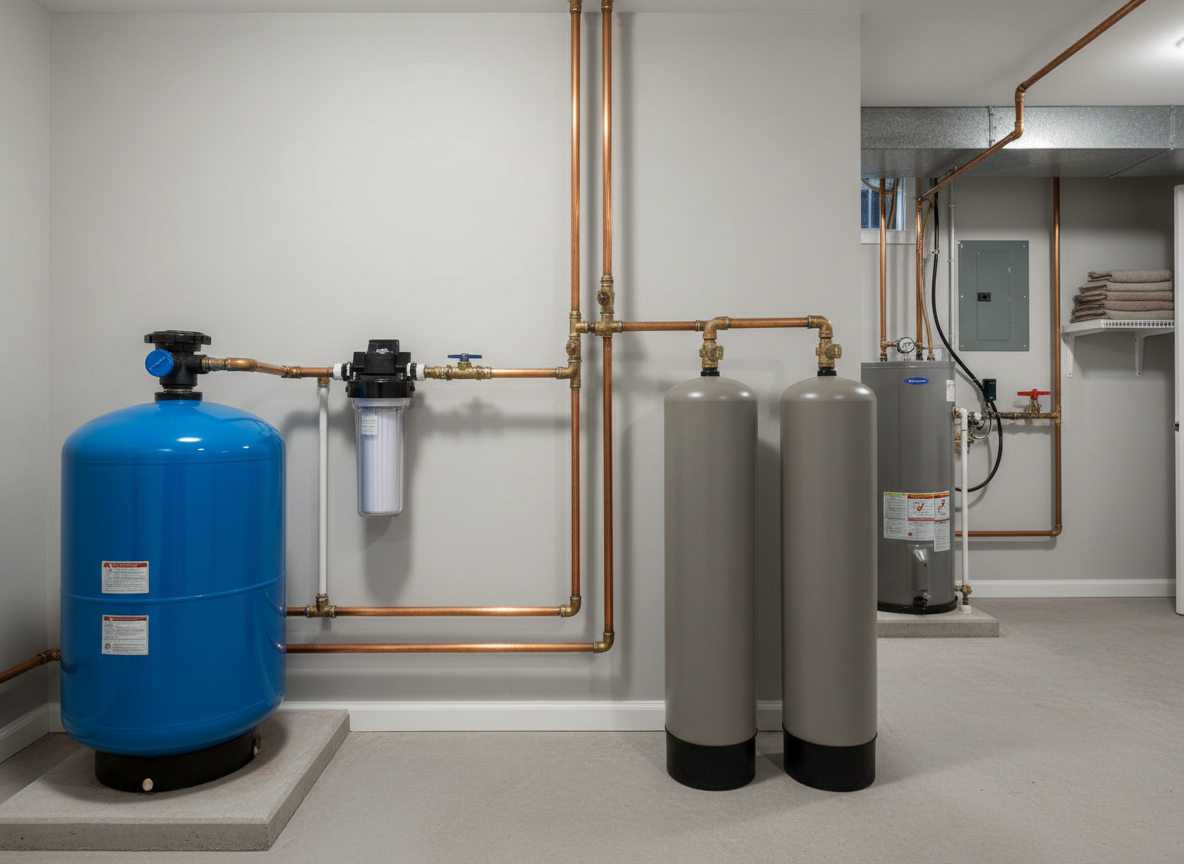
Quick answer: There is no single “best” whole house water filter for well water. The right system depends on what is actually in your water, so test first at a state-certified lab, then match each problem to a treatment: sediment filters for grit, oxidizing filters for iron and sulfur, a softener for hardness, an acid neutralizer for low pH, and UV for bacteria. Size everything to your home’s peak flow rate and look for NSF/ANSI certification.
As the Minnesota Department of Health puts it, no single treatment unit removes all contaminants. Homes that need treatment often end up with two or three units working in sequence, called a treatment train.
Step 1: Test before you buy anything
Penn State Extension advises testing at a state-certified laboratory before buying equipment, and warns about companies that use colorful in-home tests to pressure homeowners into buying on the spot.
For choosing equipment, a basic panel should include:
- Total coliform bacteria, nitrate, pH and TDS (the annual baseline in our well water testing guide)
- Hardness, iron and manganese, which drive most whole-house decisions
- Hydrogen sulfide if the water smells like rotten eggs
- Arsenic or other local contaminants your health department flags
Knowing whether iron is dissolved (clear water that turns orange) or already oxidized (orange out of the tap) changes which filter works.
Step 2: Match each problem to a treatment
“Whole house” (point-of-entry) equipment treats all the water entering the home. “Point-of-use” equipment, such as an under-sink unit, treats only the water at one tap. Some health problems are handled more practically at a single drinking-water tap.
| Problem in your test | Treatment that fits | Whole house or one tap? |
|---|---|---|
| Sand, grit, cloudiness | Sediment filter | Whole house |
| Hardness (scale, spots) | Water softener (ion exchange) | Whole house |
| Dissolved iron under 5 mg/L | Water softener, if pH is above 6.7 | Whole house |
| Iron and manganese around 3 to 10 mg/L combined | Oxidizing filter (manganese greensand, or Birm if pH allows) | Whole house |
| Iron or manganese above 10 mg/L | Chlorine, permanganate or peroxide feed plus filtration | Whole house |
| Hydrogen sulfide under 1 mg/L | Activated carbon filter | Whole house |
| Higher hydrogen sulfide | Aeration, oxidizing filter or chlorination plus filtration | Whole house |
| Low pH (corrosive water) | Acid neutralizing filter or soda ash feed | Whole house |
| Coliform bacteria | Fix the source, then UV disinfection | Whole house |
| Nitrate | Reverse osmosis, anion exchange or distillation | Usually one tap |
| Arsenic | Reverse osmosis or other certified arsenic treatment | Usually one tap |
Iron and manganese ranges are from Penn State Extension. A few notes on the less obvious rows:
- Softeners and iron. Penn State says softeners remove colorless, dissolved iron, but red, oxidized iron clogs the resin. Softening also adds sodium, roughly 7.5 mg per quart for each grain per gallon of hardness removed.
- Birm and pH. Birm-type filters avoid chemical regeneration but need a minimum pH of about 6.8 for iron and 7.5 for manganese, according to Penn State.
- Acid neutralizers raise hardness. Calcite-style neutralizing filters work by dissolving alkaline media into the water. Penn State notes this increases hardness, which is necessary for corrosion control. Soda ash injection raises pH without adding hardness. See well water pH for details.
- Nitrate and arsenic. Softeners and carbon filters do not remove arsenic, and boiling concentrates both arsenic and nitrate (Minnesota Department of Health, Penn State). Penn State estimates reverse osmosis rejects about 83 to 92 percent of incoming nitrate, so test the treated water afterward. See reverse osmosis for well water, nitrate in well water and arsenic in well water.
- Bacteria. A positive coliform test means something is getting into the well. Find and fix that first, then shock the well. UV is for ongoing protection, not a substitute for repairing a cracked cap or bad casing.
Step 3: Put the equipment in the right order
Each stage protects the next. A common sequence after the pressure tank:
- Sediment filter. Catches grit and particles that would clog everything downstream.
- pH correction. A neutralizing filter goes here if you need one. (A soda ash feed pump is installed before the pressure tank instead, which Penn State notes avoids the pressure drop some neutralizing filters cause.) Raising pH first also helps iron filters work.
- Iron, manganese and sulfur removal. Oxidizing filter, or chemical feed plus contact tank plus filter.
- Water softener. Placed after iron removal so oxidized iron does not foul the resin, and after the neutralizer, which adds hardness.
- Carbon filter. Removes leftover chlorine taste if you use chlorine feed, plus odors.
- UV disinfection, last. UV light penetrates only a short distance into water, so the Connecticut Department of Public Health notes UV units are often paired with filters that clear the water first.
Point-of-use reverse osmosis goes under the kitchen sink, after all the whole-house equipment.
Step 4: Size it for your flow rate and plumbing
Undersized equipment causes pressure drops when two fixtures run at once. Size to your peak flow in gallons per minute (gpm), not just the number of people.
Virginia Tech’s well water program suggests these minimum flow rates:
| Home size | Recommended minimum flow |
|---|---|
| 2 bedrooms, 1 bath | 6 gpm |
| 3 bedrooms, 2 baths | 10 gpm |
| 4 bedrooms, 3 baths | 14 gpm |
| 6 bedrooms, 3 baths | 18 gpm |
For reference, the same publication lists a shower at about 5 gpm, a kitchen sink at 3 gpm and a bathroom sink at 2 gpm. Practical sizing tips:
- Match or exceed peak flow. Every filter, softener valve and UV unit carries a rated service flow. Pick equipment rated at or above your peak demand.
- Check your well, too. Treatment cannot deliver more water than your pump and well produce. If pressure is already weak, sort that out first (see low water pressure from a well).
- Match pipe and valve size. Choose equipment with connections at least as large as your main line so the filter does not become a bottleneck. Ask the installer to confirm the pressure drop at your peak flow.
- Backwashing filters need extra water. Softeners and backwashing iron filters regenerate with a burst of water (Penn State cites about 50 gallons per softener regeneration). Your well must be able to supply that backwash flow.
Step 5: Look for the right NSF/ANSI certification
Penn State and the Minnesota Department of Health both recommend equipment certified by an independent body such as NSF, UL or the Water Quality Association. The certification should list the specific contaminant you need removed, not just the standard number.
| Standard | What it covers |
|---|---|
| NSF/ANSI 42 | Aesthetic effects: chlorine, taste, odor and particulates. Not health contaminants. |
| NSF/ANSI 53 | Health effects: reduction of specific health-related contaminants, such as lead, Cryptosporidium and VOCs. |
| NSF/ANSI 44 | Residential cation exchange water softeners. |
| NSF/ANSI 55 | UV systems. Class A (40 mJ/cm2) is designed to disinfect contaminated water of bacteria, viruses, Giardia and Cryptosporidium. Class B (16 mJ/cm2) is only for supplemental treatment of water already considered acceptable. |
| NSF/ANSI 58 | Reverse osmosis drinking water systems. |
For a well with a bacteria history, a Class B UV unit is not the right choice. Look for Class A.
Step 6: Budget for maintenance
The Minnesota Department of Health warns that poorly maintained treatment units lose effectiveness and in some cases can make water quality worse. Before you buy, ask what you will have to do and what it will cost each year.
| Equipment | Typical upkeep |
|---|---|
| Sediment and carbon cartridges | Replace on schedule or when pressure drops |
| Water softener | Keep salt in the brine tank; check regeneration settings |
| Oxidizing iron filter | Regular backwashing; regenerant or chemical refills |
| Acid neutralizer | Refill media as it dissolves, every few weeks to months (Penn State) |
| UV system | Clean the sleeve; replace the lamp at least once a year (Connecticut DPH) |
| Reverse osmosis | Replace prefilters and membrane per the manual |
Retest the treated water after installation and periodically after that.
For budgeting, Penn State Extension lists whole-house filters at roughly $500 to $1,500, UV systems at $400 to $1,000 or more, and point-of-use reverse osmosis at $300 to $2,000.
Frequently asked questions
Do I need a whole house filter if I have well water?
Not always. If your certified lab results are within limits and you have no staining, scale or odor, you may not need any treatment. Buy equipment to solve a problem your test identified.
Can one whole house filter remove everything in well water?
No. Different contaminants need different processes. Most homes with multiple issues need a combination, such as a sediment filter, an iron filter and a softener.
Will a whole house carbon filter remove bacteria?
No. Carbon filters target taste, odor and some chemicals. For bacteria, fix the well, disinfect it, and use a Class A UV system if you need ongoing protection.
How big a whole house filter do I need?
Size to peak flow. As a starting point, Virginia Tech suggests about 10 gpm for a three-bedroom, two-bath home. Choose equipment rated at or above that.
Related guides
- Iron in well water: orange stains and the right filter
- What size water softener do I need?
- UV water treatment for well water
Sources
- Penn State Extension – Iron and Manganese in Private Water Systems
- Penn State Extension – Tips for Buying Water Treatment Equipment
- Minnesota Department of Health – Home Water Treatment
- Virginia Tech – Water System Planning: Estimating Water Needs
This guide is for general information. Have your water tested by a state-certified lab and consult a qualified water treatment professional before buying or installing equipment.
Leave a Reply