Quick answer: When a water softener is not working, the cause is usually simple: the salt is low, a hard salt bridge has formed in the brine tank, the bypass valve is open, or the timer lost its settings after a power outage. Less often, the brine line or injector is clogged, iron has fouled the resin, or the resin is worn out. Confirm the problem first with a hardness test strip on the water going in and coming out.
The spots are back on the glasses, the soap won’t lather, and the salt level in the tank hasn’t moved in weeks. Before you pay for a service call, work through the checklist below. By the end you’ll know whether your softener needs a two-minute fix, a cleaning, or a professional.
First, prove it: the before-and-after hardness test
Don’t guess from how the water feels. A hardness test strip tells you in a minute whether the softener is doing its job.
- Test the raw water. Fill a glass from a tap that bypasses the softener, often an outdoor spigot, or from the sampling port on the softener inlet if it has one.
- Test the softened water. Fill a second glass from the kitchen or bathroom cold tap (make sure that tap isn’t plumbed around the softener for drinking).
- Compare the numbers. A working softener should bring the treated water close to zero. One water treatment retailer treats 0 to 3 grains per gallon (gpg) as normal after softening.
Readings about the same mean the softener isn’t softening. A reading in between suggests partial bypass, too little capacity between regenerations, or the wrong hardness setting.
Pro tip: Write down your raw water hardness. You’ll need it to check the hardness setting in step 7, and a big change from past results can explain why a softener that used to keep up no longer does.
If you have a salt-free conditioner, this test won’t work, because those systems don’t remove hardness. See our salt-free vs salt-based comparison.
Water softener not working? The 10-step checklist
Work through these in order. The first five are free and take minutes.
1. Check the salt level
An empty or nearly empty brine tank is a common reason for a water softener not working. Lift the lid and look. There should be salt sitting above the water level. One retailer’s guide advises keeping the tank no more than about two-thirds full, which also helps prevent bridging.
2. Break up a salt bridge
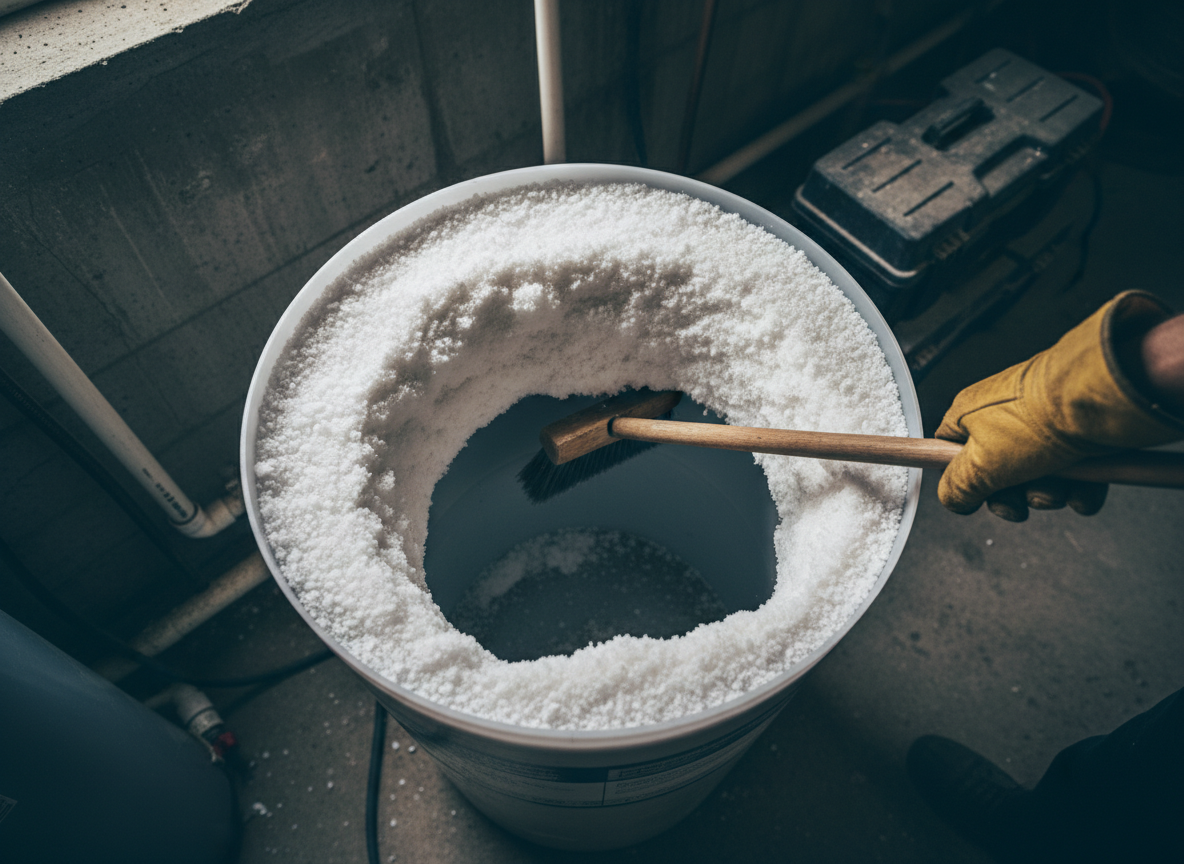
A salt bridge is a hard crust that forms across the salt, leaving a hollow space underneath. The tank looks full, but the salt can’t reach the water, so no brine forms and the resin never recharges. A classic sign: the salt level never seems to go down.
To check, push a broom handle straight down into the salt. If it hits a hard layer before the bottom of the tank, you’ve found a bridge. Gently break it up with the handle. Mistake to avoid: don’t use a sharp or pointed tool, which can puncture the tank. High humidity and the wrong type of salt make bridges more likely, so use pellet or nugget salt made for softeners.
3. Look for salt mushing
Mushing is the opposite problem: dissolved salt recrystallizes into a thick sludge at the bottom of the tank. It can block the brine intake. The fix is to scoop out the mushy salt and refill with fresh pellet salt. If it keeps happening, the tank may need a full cleaning; follow your manufacturer’s instructions.
4. Check the bypass valve
Most softeners have a bypass valve (handles, knobs or a lever) on the plumbing behind the unit. If it’s fully or partly in bypass, hard water flows around the resin tank. This often happens after a repair or a well shock treatment when nobody switches it back. Put it back in the service position.
5. Reset the clock after a power outage
Many control valves keep a clock to schedule regeneration. According to the University of Nebraska-Lincoln Extension, automatic units typically regenerate between midnight and 4 a.m. If a power outage reset the clock, the softener may be regenerating in the middle of the day or not at all. Set the correct time, then start a manual regeneration so the resin is recharged right away.
6. Check the regeneration settings
Check how often the unit regenerates and how much salt it uses per cycle. A timer-based unit set to regenerate too rarely runs out of capacity between cycles, especially if your household or water use has grown.
7. Confirm the hardness setting
Metered softeners use your hardness number to decide when to regenerate. The Minnesota Department of Health advises setting the unit to the hardness of your water supply. If you have iron, many sizing guides add 5 gpg for every 1 ppm of iron, as our softener sizing guide explains. A setting that’s too low means the resin runs out before the next regeneration.
8. Clean a clogged brine line or injector
The injector (also called the venturi or nozzle) is a small part in the control valve that creates suction to pull brine from the salt tank. Sediment or salt deposits can clog it, and a kinked or blocked brine line does the same. Signs: the salt isn’t being used, or water in the brine tank keeps rising.
Before opening the control valve, unplug the softener, put it in bypass and relieve the pressure as your owner’s manual describes. Clean the injector parts in warm soapy water with a small brush, and don’t overtighten the cap when you put it back. If you’re not comfortable taking the valve apart, this is a good point to call a pro.
9. Suspect iron-fouled resin
Well water adds a problem city water doesn’t have. Penn State Extension warns that iron that has been exposed to air or chlorine will clog the resin. The Minnesota Department of Health notes that iron and manganese can foul the resin and stop it from working, and suggests pre-filtering or a commercial resin cleaner. UNL Extension says iron above 5 ppm can reduce a softener’s effectiveness.
Clues: orange or brown staining despite the softener, rusty water after regeneration, or a softener that slowly lost capacity over months. If your iron is high, see our guide to iron in well water for an iron filter ahead of the softener.
10. Consider worn-out resin or an undersized unit
Resin doesn’t last forever. One water treatment retailer estimates standard resin typically lasts 10 to 15 years, and chlorine and iron shorten that. If everything else checks out and a fresh regeneration still doesn’t produce soft water, the resin is likely exhausted.
An undersized softener shows a different pattern: soft water right after regeneration, then hard water a few days later. Our sizing guide is built around roughly weekly regeneration; if yours needs to regenerate far more often than that, recheck the math.
Water softener troubleshooting table: match symptoms to causes
| What you notice | Most likely causes | Start with |
|---|---|---|
| Salt level never goes down | Salt bridge, clogged injector or brine line, unit not regenerating | Steps 2, 8, 5 |
| Hard water all the time, raw and treated test the same | Bypass open, empty salt tank, no regeneration | Steps 4, 1, 5 |
| Soft water right after regeneration, hard a few days later | Hardness set too low, undersized unit, worn resin | Steps 7, 10 |
| Water in the brine tank keeps rising | Clogged injector or brine line, drain line problem | Step 8 |
| Sludge at the bottom of the brine tank | Salt mushing | Step 3 |
| Orange or brown stains, rusty water after regeneration | Iron fouling the resin | Step 9 |
| Softener regenerates at odd hours | Clock reset after power outage | Step 5 |
| Slowly lost softening over months or years | Iron fouling, resin at end of life | Steps 9, 10 |
When to call a pro or replace the resin
Call a water treatment professional if:
- The control valve shows an error code, won’t cycle, or leaks.
- You’ve cleaned the injector and brine line and the unit still won’t draw brine.
- A regeneration with plenty of salt still doesn’t bring treated water close to zero.
- You suspect iron fouling and aren’t sure whether you need a resin cleaner, an iron filter or both.
Resin or a whole new softener? If the tank and control valve are in good shape, rebedding (replacing the resin) can restore performance. If the valve is old, parts are hard to find, or your household has outgrown the unit, replacement may make more sense. If your water softener is not working even after rebedding, the problem is likely your water chemistry, so get a lab test for hardness, iron and manganese first. Penn State Extension recommends using an independent lab rather than a free test from a company selling softeners.
Frequently asked questions
How do I know if my water softener is working?
Use a hardness test strip on raw water and on softened water. If the softened water reads close to zero and the raw water is hard, it’s working. Falling salt levels and regular regeneration are good signs too.
Why is my water softener not using salt?
The most common reasons are a salt bridge, a clogged injector or brine line, or a softener that isn’t regenerating because of a clock or setting problem. Probe the salt with a broom handle first.
Why is my water softener not softening the water?
Check that the bypass valve is in service, the hardness setting matches your water, and the brine tank had enough salt. If all are fine, suspect iron-fouled or worn-out resin.
How long does water softener resin last?
One retailer estimates 10 to 15 years for standard resin, but iron and chlorine in the water can shorten it. A gradual loss of softening over years is the typical sign.
Related guides
- What size water softener do I need?
- Hard well water: what it is and how to treat it
- Iron in well water: orange stains and the right filter
Sources
- Minnesota Department of Health – Home Water Softening Frequently Asked Questions
- Penn State Extension – Water Softening
- University of Nebraska-Lincoln Extension – Drinking Water Treatment: Water Softening (Ion Exchange)
- Mid Atlantic Water – Water Softener Troubleshooting
This guide is for general information. Unplug the softener before working on the control valve, follow your owner’s manual, and call a qualified water treatment professional for repairs you’re not comfortable doing.
Leave a Reply